Mastering 2026 FDA AI Regulations: Compliance for MedTech Startups

Navigating the 2026 FDA AI Regulations: 3 Key Compliance Strategies for MedTech Startups
The dawn of 2026 is rapidly approaching, bringing with it a significant paradigm shift for the MedTech industry, particularly for startups leveraging Artificial Intelligence (AI) in their medical devices. The United States Food and Drug Administration (FDA) is poised to roll out comprehensive regulations specifically targeting AI and Machine Learning (ML) in healthcare. These FDA AI Regulations are not merely an update; they represent a foundational framework designed to ensure the safety, effectiveness, and ethical deployment of AI-powered innovations. For MedTech startups, understanding and proactively implementing robust compliance strategies is not just about avoiding penalties; it’s about building trust, accelerating market entry, and ultimately, delivering life-changing technologies to patients.
The rapid advancement of AI in medical devices has opened unprecedented opportunities for diagnosis, treatment, and patient monitoring. From AI-powered diagnostic imaging tools that detect subtle anomalies to predictive analytics that forecast disease progression, the potential is immense. However, this transformative power comes with inherent complexities, including data privacy, algorithmic bias, transparency, and the continuous learning nature of many AI models. The FDA’s forthcoming FDA AI Regulations aim to address these challenges head-on, establishing clear guidelines for development, validation, deployment, and post-market surveillance.
For MedTech startups, often characterized by agile development cycles and limited resources, these regulations can seem daunting. The temptation might be to focus solely on product development, deferring regulatory considerations until later stages. This approach, however, is fraught with risk. Early integration of regulatory strategy is paramount. It ensures that AI models are designed with compliance in mind from inception, minimizing costly rework, delays, and potential roadblocks to market approval. This article delves into three key compliance strategies that MedTech startups must embrace to successfully navigate the 2026 FDA AI Regulations and thrive in this evolving landscape.
The regulatory environment for AI in healthcare is dynamic. While the FDA has previously issued guidance documents, such as the ‘Proposed Regulatory Framework for Modifications to Artificial Intelligence/Machine Learning (AI/ML)-Based Software as a Medical Device (SaMD)’ and the ‘AI/ML-Based SaMD Action Plan,’ the 2026 regulations are expected to consolidate and formalize these principles into enforceable rules. This shift from guidance to regulation underscores the FDA’s commitment to ensuring responsible innovation. Startups that proactively align their development processes with these anticipated requirements will gain a significant competitive advantage.
Strategy 1: Embed Quality Management Systems (QMS) and Regulatory by Design
One of the most critical strategies for MedTech startups to address the 2026 FDA AI Regulations is to fully embed Quality Management Systems (QMS) and adopt a ‘Regulatory by Design’ philosophy. This means that compliance is not an afterthought but an integral part of every stage of product development, from initial concept to post-market surveillance.
Defining and Implementing a Robust QMS for AI
A robust QMS, compliant with ISO 13485 and 21 CFR Part 820, is the bedrock of medical device manufacturing. For AI-powered devices, the QMS needs to be specifically tailored to address the unique characteristics of AI/ML. This includes:
- Software Development Life Cycle (SDLC) Integration: The QMS must seamlessly integrate with the software development life cycle, ensuring that all stages – requirements gathering, design, coding, testing, and deployment – adhere to regulatory standards. This involves rigorous documentation of every decision, change, and validation step related to the AI algorithm.
- Data Management and Governance: AI models are only as good as the data they are trained on. A comprehensive QMS for AI must include strict protocols for data acquisition, curation, labeling, storage, and security. This is particularly crucial for addressing potential biases in training data, which can lead to discriminatory or inaccurate outcomes. Data governance frameworks must ensure data integrity, traceability, and patient privacy (e.g., HIPAA compliance).
- Risk Management: The inherent complexities of AI introduce new types of risks. The QMS must incorporate a robust risk management process (ISO 14971) that specifically addresses AI-related risks, such as algorithmic bias, model drift, cybersecurity vulnerabilities, and unintended consequences. This involves identifying potential harms, estimating their likelihood and severity, and implementing appropriate mitigation strategies throughout the product lifecycle.
- Configuration Management: Due to the iterative nature of AI development and the potential for model updates, robust configuration management is essential. The QMS must define clear procedures for version control, change management, and documenting all modifications to the AI model, including data sets, algorithms, and deployment environments.
Regulatory by Design: Proactive Compliance
Regulatory by Design extends the QMS principles by making regulatory considerations a primary driver from the very outset of product conceptualization. Instead of developing a product and then trying to fit it into regulatory requirements, ‘Regulatory by Design’ means:
- Early Engagement with Regulatory Experts: Involve regulatory affairs professionals from the initial ideation phase. Their expertise can help identify potential regulatory hurdles and guide design choices to ensure future compliance. This proactive approach can save significant time and resources in the long run.
- Designing for Transparency and Explainability: The ‘black box’ nature of some AI models poses a challenge for regulatory oversight. Designing AI systems with inherent transparency and explainability features is becoming increasingly important. This might involve developing methods to interpret model decisions, highlight key contributing factors, or provide confidence scores. The FDA is likely to demand increasing levels of explainability for critical AI decisions.
- Scalable and Maintainable Architectures: Design AI systems that are not only effective but also scalable and maintainable within a regulated environment. This includes considering how model updates will be handled, how performance will be monitored in real-world settings, and how potential issues will be addressed post-market.
- Pre-Submission Meetings: Engage with the FDA early in the development process through pre-submission meetings. These interactions provide an invaluable opportunity to discuss the regulatory pathway for your specific AI-powered device, gain feedback on your proposed approach, and clarify any ambiguities regarding the FDA AI Regulations.
By embedding a tailored QMS and adopting a Regulatory by Design philosophy, MedTech startups can build a strong foundation for compliance, ensuring that their AI innovations are not only technologically advanced but also safe, effective, and ready for market approval under the new FDA AI Regulations.
Strategy 2: Robust AI Model Validation and Performance Monitoring
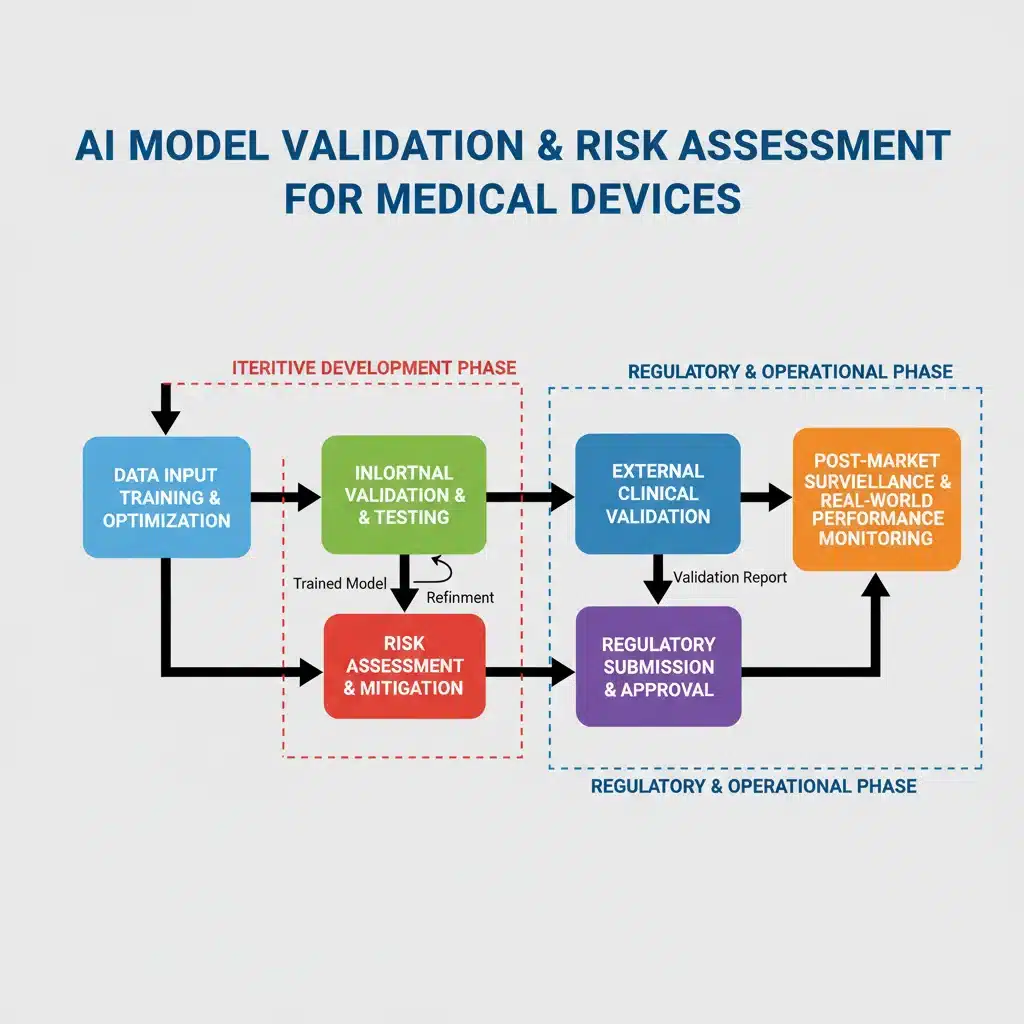
The core of any AI-powered medical device is its algorithm. Therefore, comprehensive validation and continuous performance monitoring are paramount for complying with the 2026 FDA AI Regulations. This strategy focuses on demonstrating the reliability, accuracy, and safety of the AI model throughout its lifecycle.
Rigorous Validation Methodologies
AI model validation goes beyond traditional software testing. It requires a multi-faceted approach to ensure the model performs as intended across diverse patient populations and clinical scenarios. Key aspects include:
- Independent Data Sets: Validation must be performed on independent, representative data sets that were not used during training or development. These data sets should reflect the intended use population and account for variability in demographics, disease prevalence, and data acquisition methods.
- Performance Metrics Tailored to Clinical Endpoints: Define clear, clinically relevant performance metrics (e.g., sensitivity, specificity, accuracy, precision, F1 score) that directly correlate with the device’s intended use and patient outcomes. These metrics should be established upfront and used to evaluate the model’s performance against predefined acceptance criteria.
- Bias Detection and Mitigation: A critical component of validation is the rigorous assessment for algorithmic bias. This involves analyzing model performance across different demographic groups (e.g., age, gender, ethnicity) to ensure equitable and fair outcomes. If biases are detected, strategies for mitigation, such as data re-sampling, algorithm adjustments, or post-processing techniques, must be implemented and re-validated.
- Adversarial Robustness Testing: AI models can be vulnerable to adversarial attacks, where small, imperceptible perturbations to input data can lead to erroneous outputs. Validation should include testing for adversarial robustness to ensure the model’s resilience against such manipulations, which could have serious clinical implications.
- Explainability and Interpretability Assessments: As mentioned earlier, the ability to understand how an AI model arrives at its decisions is increasingly important. Validation should include assessments of the model’s explainability, ensuring that clinicians can comprehend and trust its recommendations. This might involve evaluating saliency maps, feature importance scores, or counterfactual explanations.
Continuous Performance Monitoring and Model Drift Management
Unlike traditional software, many AI/ML models can adapt and learn over time, a phenomenon known as ‘model drift.’ While this can be a powerful feature, it also poses significant regulatory challenges. The 2026 FDA AI Regulations are expected to place a strong emphasis on continuous monitoring and effective management of model changes.
- Real-World Performance Monitoring: Once deployed, AI-powered medical devices must be continuously monitored in real-world clinical settings. This involves collecting real-world performance data and comparing it against established benchmarks. Deviations or degradation in performance must trigger predefined alert systems and investigation protocols.
- Pre-Specified Update Plans (PSUPs): For adaptive AI models, the FDA has introduced the concept of Pre-Specified Update Plans (PSUPs). Startups developing such models must define clear, prospective plans for how model modifications will be managed, including the types of changes that can be made, the data used for retraining, the validation protocols for updated models, and the criteria for acceptable performance. These plans need to be established and agreed upon with the FDA prior to market authorization.
- Change Control and Re-validation: Any significant change to the AI model, whether it’s a software update, a change in the training data, or an algorithmic modification, must undergo a rigorous change control process. This includes thorough documentation of the change, re-validation of the updated model, and assessment of its impact on safety and effectiveness. Depending on the nature of the change, additional regulatory submissions may be required.
- Post-Market Surveillance for AI: The QMS must extend to post-market surveillance, specifically tailored for AI. This includes mechanisms for collecting feedback on model performance, identifying emerging risks, and promptly addressing any issues. This continuous feedback loop is crucial for maintaining the safety and effectiveness of AI devices over their lifetime.
By implementing robust validation methodologies and continuous performance monitoring, MedTech startups can demonstrate ongoing assurance of their AI models’ safety and efficacy, thereby meeting the stringent requirements of the 2026 FDA AI Regulations.
Strategy 3: Prioritize Data Privacy, Security, and Ethical AI Principles
In an era where data is the lifeblood of AI, ensuring its privacy and security is non-negotiable. Furthermore, the ethical implications of AI in healthcare are gaining increasing scrutiny. The 2026 FDA AI Regulations will undoubtedly reflect these concerns, making data governance and ethical AI principles foundational for compliance.
Comprehensive Data Privacy and Security Measures
MedTech startups must implement a multi-layered approach to protect sensitive patient data used by their AI devices:
- HIPAA Compliance: For any AI system dealing with Protected Health Information (PHI) in the United States, adherence to the Health Insurance Portability and Accountability Act (HIPAA) is mandatory. This includes stringent measures for safeguarding PHI during data collection, storage, processing, and transmission.
- Data Anonymization and De-identification: Whenever possible, utilize anonymized or de-identified data for AI model training and validation. Implement robust techniques to ensure that individuals cannot be re-identified from the data, even through sophisticated methods.
- Cybersecurity Protocols: AI-powered medical devices, often connected and data-intensive, are prime targets for cyber threats. Implement industry-leading cybersecurity measures, including encryption, access controls, intrusion detection systems, and regular security audits. The FDA’s focus on cybersecurity for medical devices is intensifying, and AI systems will be under particular scrutiny.
- Secure Data Storage and Transmission: Ensure that all data, both at rest and in transit, is adequately secured. This involves using secure cloud platforms, encrypted databases, and secure communication protocols to prevent unauthorized access or data breaches.
- Data Minimization: Adopt the principle of data minimization, collecting and retaining only the data that is absolutely necessary for the AI model’s intended purpose. This reduces the attack surface and mitigates privacy risks.
Embracing Ethical AI Principles
Beyond technical compliance, the FDA and the broader healthcare community are increasingly emphasizing ethical considerations in AI development. Incorporating ethical AI principles is not just good practice; it’s becoming a regulatory expectation.
- Fairness and Equity: Actively work to prevent and mitigate algorithmic bias that could lead to unfair or discriminatory outcomes for certain patient populations. This requires careful consideration of training data diversity, rigorous bias detection during validation, and transparent reporting of limitations.
- Transparency and Explainability: As discussed earlier, strive for AI models that are as transparent and explainable as possible. This builds trust among clinicians and patients and allows for better understanding of the model’s strengths and weaknesses.
- Accountability: Clearly define lines of responsibility and accountability for the AI system’s performance, particularly in the event of errors or adverse events. This includes establishing clear processes for error reporting, investigation, and remediation.
- Human Oversight: Ensure that AI systems are designed to augment, not replace, human decision-making. Maintain appropriate levels of human oversight, allowing clinicians to review, override, and understand AI recommendations. The ‘human in the loop’ concept remains critical in healthcare AI.
- Patient-Centric Design: Develop AI solutions with the patient at the center. This includes involving patients in the design process, considering their preferences and values, and ensuring that the AI truly improves their health outcomes and experience.

By prioritizing data privacy, robust security, and ethical AI principles, MedTech startups can build trust with regulators, healthcare providers, and patients, positioning themselves as responsible innovators in the AI healthcare space and ensuring smooth navigation of the FDA AI Regulations.
The Future is Now: Preparing for 2026 and Beyond
The 2026 FDA AI Regulations represent a pivotal moment for the MedTech industry. For startups, this isn’t a hurdle to overcome but an opportunity to build a sustainable and impactful business model. Early and strategic investment in compliance will differentiate market leaders from those struggling to catch up. The companies that embrace these regulations as a framework for responsible innovation will be the ones that shape the future of healthcare.
Beyond the three strategies outlined, MedTech startups should also consider:
- Building an Interdisciplinary Team: Success in AI medical device development requires collaboration between AI engineers, data scientists, clinicians, regulatory experts, and quality assurance professionals. Fostering an environment of interdisciplinary cooperation is crucial.
- Staying Informed: The regulatory landscape for AI is continuously evolving. Stay abreast of new FDA guidance documents, workshops, and industry best practices. Engage with professional organizations and regulatory consultants to ensure ongoing compliance.
- Resource Allocation: Allocate sufficient resources – financial, human, and technological – to regulatory affairs and quality management. Viewing these as investments rather than costs will yield significant returns in terms of market access and patient safety.
- Documentation, Documentation, Documentation: The FDA operates on the principle of ‘if it isn’t documented, it didn’t happen.’ Meticulous record-keeping of all development, validation, risk management, and post-market activities is absolutely essential.
The integration of AI into medical devices promises to revolutionize healthcare, making it more precise, personalized, and proactive. However, this revolution must be underpinned by a steadfast commitment to safety, effectiveness, and ethical considerations. The 2026 FDA AI Regulations are designed to ensure just that. By proactively adopting comprehensive quality management systems, implementing robust AI model validation and monitoring, and prioritizing data privacy, security, and ethical AI principles, MedTech startups can confidently navigate this new regulatory era, bring their transformative technologies to market, and ultimately, improve patient lives on a global scale.
Conclusion: A Proactive Stance for Sustainable Innovation
In conclusion, the impending 2026 FDA AI Regulations are not just a regulatory update; they are a call to action for MedTech startups. The era of ‘move fast and break things’ is swiftly being replaced by ‘innovate responsibly and validate thoroughly.’ Startups that embed quality, regulatory foresight, and ethical considerations into their core development processes from day one will be best positioned for success.
The three strategies discussed – embedding QMS and Regulatory by Design, robust AI model validation and performance monitoring, and prioritizing data privacy, security, and ethical AI principles – provide a comprehensive roadmap. Each strategy is interconnected and mutually reinforcing, creating a holistic approach to compliance. Ignoring any one of these pillars risks not only regulatory non-compliance but also reputational damage and, most importantly, potential harm to patients.
The journey to market for AI-powered medical devices will be complex, but with a proactive, strategic, and patient-centric approach to regulatory compliance, MedTech startups can confidently navigate the challenges and seize the immense opportunities that the future of AI in healthcare holds. The time to prepare for the 2026 FDA AI Regulations is now, ensuring that innovation and patient safety advance hand-in-hand.