MedTech Startup Pilots: Securing Health System Partnerships in 2026

The healthcare landscape is in a constant state of flux, driven by technological advancements, evolving patient expectations, and the relentless pursuit of improved outcomes. For MedTech startups, this dynamic environment presents both immense opportunities and significant challenges. Breaking into major health systems, securing pilot programs, and ultimately integrating innovative solutions can be a daunting task. However, with the right strategies and a deep understanding of the intricate workings of these complex organizations, securing multiple pilot programs in 2026 is not just a dream, but an achievable goal for ambitious MedTech ventures. This comprehensive guide delves into the insider knowledge and practical solutions necessary for MedTech startups to forge successful MedTech Health System Partnerships and secure at least three pilot programs next year.
The journey from an innovative idea to widespread adoption within a major health system is often protracted and filled with hurdles. Health systems, by their very nature, are risk-averse, highly regulated, and operate on extensive procurement cycles. Their primary focus remains patient safety and efficacy, meaning any new technology must demonstrate clear value, seamless integration, and robust evidence. This article aims to demystify this process, providing actionable insights for startups looking to navigate the labyrinthine corridors of healthcare institutions and establish meaningful, long-term MedTech Health System Partnerships.
Understanding the Health System Landscape: A Prerequisite for Successful Partnerships
Before even thinking about approaching a health system, it is crucial for MedTech startups to gain a profound understanding of their target organizations. No two health systems are identical, and their priorities, technological infrastructure, and decision-making processes can vary significantly. A superficial understanding will inevitably lead to misaligned pitches and wasted efforts. To truly succeed in forming MedTech Health System Partnerships, startups must conduct thorough due diligence.
Identifying Key Stakeholders and Their Motivations
Major health systems are comprised of numerous departments, committees, and individuals, all with their own agendas and influence. Identifying and understanding the roles of key stakeholders is paramount. These often include:
- Clinical Leaders: Physicians, nurses, and other care providers who will be the end-users of your technology. Their buy-in is critical, as they are the ones who will champion its use and provide crucial feedback. Understanding their pain points and how your solution directly addresses them is vital.
- IT Departments: Responsible for integration, data security, interoperability, and maintenance. They are often gatekeepers and can make or break a pilot. Early engagement and demonstrating a clear understanding of their technical requirements are essential for successful MedTech Health System Partnerships.
- Procurement and Supply Chain: Focus on cost-effectiveness, contract terms, and vendor management. They need to be convinced of the financial value and scalability of your solution.
- Innovation Centers/Departments: Many large health systems now have dedicated innovation hubs or teams actively seeking new technologies. These can be excellent entry points for MedTech startups.
- Executive Leadership: CEOs, CFOs, CMOs, and other senior executives who set strategic priorities and control budgets. Their support is often necessary for larger-scale pilots and eventual adoption.
Each of these stakeholders has different metrics for success and different concerns. A successful engagement strategy for MedTech Health System Partnerships involves tailoring your message to resonate with each group, highlighting the specific benefits that matter most to them.
Navigating Organizational Structure and Decision-Making Processes
Health systems often have complex, hierarchical structures. Decisions are rarely made by a single individual but rather through committees, task forces, and consensus-building processes. Understanding the typical procurement cycle, clinical review boards, and budget approval processes is non-negotiable. This involves:
- Mapping the Decision Journey: Who needs to approve what, and in what order? What are the typical timelines?
- Understanding Budget Cycles: When do departments plan their budgets? Aligning your outreach with their planning cycles can significantly increase your chances of securing funding for a pilot.
- Recognizing Internal Politics: While often unspoken, internal politics play a significant role. Identifying internal champions who can advocate for your solution from within can be incredibly powerful for establishing strong MedTech Health System Partnerships.
Crafting an Irresistible Value Proposition for Health Systems
Health systems are not looking for "cool technology"; they are looking for solutions to their most pressing problems. Your value proposition must clearly articulate how your MedTech solution addresses a critical pain point, improves patient outcomes, enhances operational efficiency, or reduces costs. This is the cornerstone of any successful MedTech Health System Partnership.
Focus on Solvable Problems, Not Just Features
Instead of leading with a list of features, start with the problem your technology solves. For example, rather than saying "Our AI provides predictive analytics," say "Our AI reduces hospital readmission rates by identifying at-risk patients earlier." Quantifiable benefits are extremely persuasive. Consider:
- Clinical Outcomes: How does your solution improve diagnosis accuracy, treatment efficacy, patient safety, or reduce complications?
- Operational Efficiency: Does it streamline workflows, reduce staff burden, optimize resource utilization, or decrease wait times?
- Financial Impact: Can it lower costs, increase revenue, improve reimbursement, or reduce waste?
- Patient Experience: Does it enhance patient engagement, satisfaction, or access to care?
Provide compelling evidence to back up your claims. This could include preliminary study results, case studies from early adopters, or even robust theoretical models. Forging strong MedTech Health System Partnerships requires trust, and trust is built on evidence.
Demonstrating ROI and Scalability
Health systems operate on tight margins, and any new investment must demonstrate a clear return on investment (ROI). Develop a compelling business case that outlines the financial benefits of your solution. This might involve:
- Calculating potential cost savings (e.g., reduced length of stay, fewer adverse events, optimized staffing).
- Projecting revenue enhancements (e.g., increased patient volume, new service lines).
- Highlighting improvements in quality metrics that can impact reimbursement.
Furthermore, health systems need to know that if a pilot is successful, your solution can scale to meet their needs across multiple departments or even facilities. Discuss your scalability plans, technical architecture, and support capabilities early on to reassure them about future MedTech Health System Partnerships.
Strategic Approaches to Securing Pilot Programs in 2026
Securing three or more pilot programs requires a multi-pronged, strategic approach. It’s not about a single "magic bullet" but rather a combination of targeted outreach, relationship building, and meticulous preparation.
Leveraging Existing Networks and Industry Events
Networking remains an invaluable tool. Attend industry conferences, MedTech expos, and healthcare innovation summits. These events provide unparalleled opportunities to meet potential partners, understand market needs, and showcase your technology. Actively participate in panel discussions, pitch competitions, and one-on-one meetings. Seek introductions through advisors, investors, and existing contacts. Warm introductions are always more effective than cold calls when pursuing MedTech Health System Partnerships.
Targeted Outreach and Customization
Avoid generic pitches. Research each health system thoroughly and tailor your outreach to their specific needs, strategic goals, and patient population. Identify their published priorities (e.g., reducing readmissions for a specific condition, improving telehealth access, enhancing data security) and explicitly demonstrate how your solution aligns with those objectives. A customized approach shows you’ve done your homework and are serious about building genuine MedTech Health System Partnerships.
The Power of the "Pilot Program"
For health systems, a pilot program is a controlled experiment designed to evaluate the effectiveness, feasibility, and impact of a new technology before full-scale adoption. For MedTech startups, it’s a critical stepping stone to market validation and scaling. Frame your initial ask as a pilot program, emphasizing its limited scope, defined objectives, and clear success metrics. This reduces the perceived risk for the health system. Be prepared to:
- Define Clear Objectives: What specific problem will the pilot solve? What are the measurable outcomes?
- Establish Success Metrics: How will success be quantitatively measured (e.g., reduction in errors, time saved, patient satisfaction scores)?
- Outline a Detailed Plan: What are the phases of the pilot? Who will be involved? What resources are needed from both sides?
- Set a Realistic Timeline: Pilots should be long enough to gather meaningful data but short enough to maintain momentum.
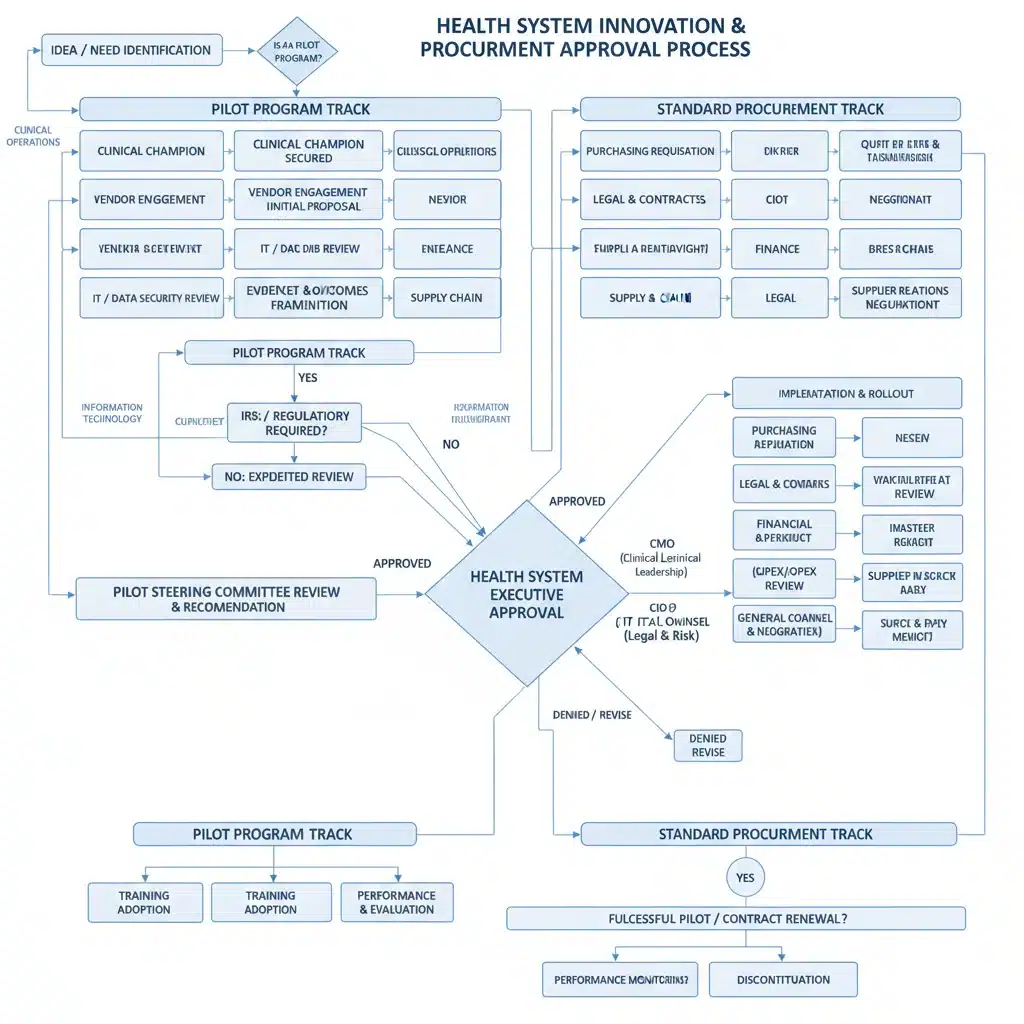
Navigating the Procurement and Legal Labyrinth
Once a health system expresses interest, the real work of formalizing the pilot begins. This often involves navigating complex procurement processes, legal reviews, and contractual negotiations. This stage can be a significant bottleneck for many startups, highlighting the importance of preparation for successful MedTech Health System Partnerships.
Understanding Procurement Requirements
Health systems have stringent procurement rules designed to ensure fairness, transparency, and fiscal responsibility. Be prepared for:
- RFPs (Requests for Proposals) or RFIs (Requests for Information): While pilots might sometimes bypass a full RFP, understanding the information typically requested can help you prepare your documentation.
- Vendor Credentialing: Expect a thorough vetting process, including financial stability checks, insurance requirements, and compliance with various regulations.
- Due Diligence: Health systems will examine your company’s stability, team expertise, and track record.
Data Security, Privacy, and Regulatory Compliance (HIPAA, GDPR)
This is arguably the most critical area for any MedTech solution. Health systems are custodians of sensitive patient data and face severe penalties for breaches. Your solution must be demonstrably compliant with relevant data privacy regulations (e.g., HIPAA in the US, GDPR in Europe) and adhere to the highest standards of cybersecurity. Be ready to provide:
- Security Architecture Documentation: How is data encrypted, stored, and accessed?
- Privacy Policies: Clear statements on how patient data is handled.
- Compliance Certifications: Any relevant certifications (e.g., SOC 2, ISO 27001) will significantly bolster your credibility.
- Business Associate Agreements (BAAs): Essential for any vendor handling Protected Health Information (PHI). Negotiating BAAs can be complex and time-consuming, so having a legal team well-versed in healthcare law is crucial for establishing robust MedTech Health System Partnerships.
Contractual Agreements and Intellectual Property
Pilot agreements, service level agreements (SLAs), and data use agreements are standard. Pay close attention to:
- Scope of Work: Clearly defines what will be done, by whom, and within what timeframe.
- Payment Terms: While some pilots might be unpaid or low-cost, aim for fair compensation that reflects the value you bring and the resources you expend.
- Intellectual Property (IP): Ensure your IP is protected and clearly delineate ownership of any new IP generated during the pilot.
- Exit Clauses: What happens if the pilot is unsuccessful or if either party wishes to terminate?
Do not underestimate the time and resources required for legal review. Having standard templates and being prepared to negotiate can significantly expedite this phase of forming MedTech Health System Partnerships.
Executing a Successful Pilot Program and Beyond
Securing a pilot is just the beginning. The success of the pilot program itself is what paves the way for broader adoption and future MedTech Health System Partnerships.
Dedicated Project Management and Support
Assign a dedicated project manager from your team to oversee the pilot. This individual will be the primary point of contact for the health system, ensuring smooth communication, addressing issues promptly, and keeping the project on track. Provide robust training and ongoing technical support to end-users. A positive user experience during the pilot is paramount.
Collecting and Analyzing Data Rigorously
The pilot program is an opportunity to gather real-world evidence of your solution’s impact. Work closely with the health system to collect relevant data, both quantitative (e.g., clinical metrics, efficiency gains) and qualitative (e.g., user feedback, testimonials). Rigorously analyze this data to demonstrate the value proposition you initially presented. Be transparent with the results, even if they uncover areas for improvement. This iterative feedback loop is crucial for refining your product and strengthening MedTech Health System Partnerships.
Showcasing Success and Planning for Scale
Upon successful completion of the pilot, present the results to key stakeholders within the health system. Highlight how your solution met or exceeded the defined success metrics. Develop a clear proposal for scaling the solution across other departments, facilities, or patient populations. This is the moment to transition from a pilot to a more permanent, extensive MedTech Health System Partnership.

Insider Knowledge and Practical Solutions for 2026
Beyond the general strategies, certain insider tips can give MedTech startups a significant edge in securing multiple pilot programs in 2026 and fostering strong MedTech Health System Partnerships.
"Land and Expand" Strategy
Instead of aiming for a massive, system-wide deployment from day one, focus on securing a small, well-defined pilot in one department or clinic. Prove your value there, gather data, and then use that success as a case study to "expand" to other areas within the health system. This "land and expand" approach mitigates risk for the health system and provides a clear pathway for your solution’s growth. It’s a proven method for building sustainable MedTech Health System Partnerships.
Leveraging Clinical Champions
Finding and cultivating clinical champions within the health system is invaluable. These are clinicians who are passionate about innovation, recognize the value of your solution, and are willing to advocate for it internally. They can help navigate internal politics, provide crucial feedback, and influence decision-makers. Actively seek out these individuals and empower them with the information and support they need to champion your cause for robust MedTech Health System Partnerships.
Emphasizing Interoperability and Integration
Health systems are increasingly burdened by disparate systems that don’t communicate with each other. Solutions that emphasize interoperability and seamless integration with existing EHRs (Electronic Health Records) and other IT infrastructure will be highly favored. Demonstrate your commitment to open standards and provide clear documentation on your APIs and integration capabilities. This significantly reduces the IT burden on the health system and makes your solution more attractive for long-term MedTech Health System Partnerships.
Focusing on "Low-Hanging Fruit" Pilot Opportunities
Sometimes, the quickest path to a pilot is by addressing a relatively simpler, yet impactful, problem. Instead of tackling a complex, system-wide transformation, look for opportunities where your solution can provide immediate, measurable value with minimal disruption. These "low-hanging fruit" pilots can build trust and demonstrate your capabilities, opening doors for more significant projects and deeper MedTech Health System Partnerships down the line.
Building a Strong Advisory Board
Consider recruiting healthcare leaders, former health system executives, or experienced clinicians to your advisory board. Their insights, connections, and credibility can be instrumental in opening doors, providing strategic guidance, and helping you tailor your approach to health systems. An advisory board composed of respected industry veterans can significantly enhance your chances of securing valuable MedTech Health System Partnerships.
Being Prepared for a Long Sales Cycle
The sales cycle for health systems is notoriously long, often spanning 12-18 months or even longer. Startups must have sufficient runway and patience to navigate this extended process. Don’t get discouraged by initial delays or rejections. Persistence, coupled with a willingness to adapt and refine your approach, is key to ultimately fostering successful MedTech Health System Partnerships.
The Role of Data and AI in Driving Adoption
In 2026, health systems will continue to prioritize solutions that leverage data and artificial intelligence to improve decision-making, personalize care, and predict outcomes. If your MedTech solution incorporates AI or advanced data analytics, clearly articulate how these technologies provide actionable insights and drive measurable improvements. Demonstrate how your solution can help health systems move towards value-based care models, a major strategic imperative for many organizations and a compelling argument for establishing strong MedTech Health System Partnerships.
Conclusion: Paving the Way for Transformative MedTech Health System Partnerships
Securing three or more pilot programs with major health systems in 2026 is an ambitious but entirely attainable goal for MedTech startups. It requires a blend of innovative technology, strategic foresight, meticulous preparation, and unwavering persistence. By profoundly understanding the health system landscape, crafting an irresistible value proposition, navigating complex procurement processes, and executing successful pilots, startups can not only validate their solutions but also become integral partners in transforming healthcare delivery.
The journey to establishing robust MedTech Health System Partnerships is not linear, but by focusing on solving real-world problems, demonstrating clear ROI, prioritizing data security and interoperability, and cultivating strong relationships with key stakeholders, MedTech startups can unlock unprecedented opportunities for growth and make a lasting impact on patient care. The future of healthcare innovation hinges on these collaborations, and 2026 is poised to be a pivotal year for startups ready to meet the challenge.