
The landscape of healthcare is on the cusp of a monumental transformation, largely driven by the accelerating integration of Artificial Intelligence (AI). This revolution isn’t happening in a vacuum; it’s being significantly propelled by strategic investments, particularly federal funding. As we look towards 2026, the allocation of federal grants for AI in healthcare is set to become a primary catalyst, shaping the future of medical innovation, patient care, and the financial health of the healthcare ecosystem. Understanding the intricacies of this AI healthcare funding is crucial for stakeholders across the board, from researchers and startups to established healthcare providers and policymakers.
The promise of AI in healthcare is vast, encompassing everything from accelerating drug discovery and personalizing treatment plans to optimizing hospital operations and enhancing diagnostic accuracy. However, realizing this potential requires substantial capital investment, robust infrastructure, and a concerted effort from various sectors. Federal governments globally recognize this imperative, and in the United States, the focus on bolstering domestic capacity for AI development and deployment in health is intensifying. The year 2026 is emerging as a pivotal moment, with new grant programs and expanded existing initiatives designed to funnel significant resources into this burgeoning field. This influx of AI healthcare funding is not merely about providing financial aid; it’s about strategically directing innovation towards areas of greatest need and potential impact.
The Strategic Imperative: Why Federal Funding for AI in Healthcare is Crucial
The rationale behind substantial federal investment in AI for healthcare is multi-faceted. Firstly, there’s a national security dimension. Dominance in advanced technologies like AI is increasingly seen as critical for a nation’s economic competitiveness and strategic independence. By fostering domestic AI capabilities in healthcare, countries aim to secure their leadership in a globally competitive technological race. Secondly, and perhaps more directly, there’s the pressing need to address persistent and emerging challenges within healthcare systems. These include rising costs, workforce shortages, disparities in access to care, and the ever-present threat of new diseases.
AI offers solutions to many of these problems. For instance, AI-powered diagnostic tools can help overcome shortages of specialists in rural areas, while AI-driven drug discovery platforms can accelerate the development of life-saving medications. Personalized medicine, tailored to an individual’s genetic makeup and lifestyle, becomes a more attainable reality with advanced AI algorithms. However, the development and integration of such sophisticated technologies are expensive and often carry significant risks. This is where federal funding steps in, acting as a crucial de-risking mechanism and providing the foundational capital that private investment alone might hesitate to supply, especially in the early, high-risk stages of research and development. The AI healthcare funding coming in 2026 is specifically designed to bridge these gaps and accelerate the transition of promising research into practical, deployable solutions.
Addressing Market Failures and Promoting Public Good
One of the key justifications for federal intervention is the concept of market failure. Certain types of research, particularly foundational AI research or applications targeting rare diseases, may not offer sufficient short-term financial returns to attract significant private investment. Federal grants, therefore, ensure that these critical areas are not neglected. Moreover, healthcare is fundamentally a public good. Innovations that improve public health, even if not immediately profitable, contribute immensely to societal well-being. Federal funding for AI in healthcare embodies this principle, aiming to foster advancements that benefit all citizens, regardless of their ability to pay for cutting-edge treatments initially. This approach ensures that the benefits of AI are broadly distributed, reducing health disparities and promoting equitable access to advanced care.
Key Areas Targeted by 2026 Federal Grants for AI in Healthcare
While specific details of the 2026 federal grant programs are still being formalized, trends from current and preceding initiatives offer strong indicators of where the funding will be directed. The overarching goal is to foster innovation that is both scientifically rigorous and clinically impactful. Several key areas are expected to receive significant portions of this AI healthcare funding:
- Precision Medicine and Genomics: AI’s ability to process and interpret vast amounts of genomic data, clinical records, and lifestyle information is unparalleled. Federal grants will likely support projects focused on developing AI models for predicting disease risk, personalizing drug dosages, and identifying optimal treatment pathways based on individual patient profiles. This includes initiatives for AI-driven biomarker discovery and gene therapy optimization.
- Drug Discovery and Development: The traditional drug development pipeline is notoriously long and expensive. AI can revolutionize this by accelerating target identification, lead compound optimization, and even predicting drug efficacy and toxicity. Funding will be channeled into AI platforms that can sift through molecular databases, design novel compounds, and streamline preclinical trials.
- Advanced Diagnostics and Imaging: AI algorithms are already proving superior to human interpretation in certain diagnostic tasks, such as detecting subtle anomalies in medical images (radiology, pathology) or analyzing complex physiological signals. Expect grants for AI-powered diagnostic tools that improve accuracy, reduce turnaround times, and make advanced diagnostics more accessible. This also extends to early disease detection systems for conditions like cancer, Alzheimer’s, and cardiovascular diseases.
- Public Health and Population Health Management: AI can play a crucial role in analyzing public health data to predict disease outbreaks, manage epidemics, and identify population-level health trends. Funding will support AI tools for epidemiological surveillance, resource allocation during health crises, and personalized preventative care strategies for large populations.
- Healthcare Operations and Efficiency: Beyond direct patient care, AI can significantly enhance the operational efficiency of healthcare systems. This includes AI for appointment scheduling optimization, supply chain management, predictive maintenance of medical equipment, and reducing administrative burden. Grants in this area aim to free up human capital, reduce costs, and improve the overall patient experience.
- Ethical AI and Trustworthiness: As AI becomes more pervasive, ensuring its ethical deployment, fairness, transparency, and accountability is paramount. Federal funding will also be directed towards research into explainable AI (XAI), bias detection and mitigation in AI algorithms, and the development of robust regulatory frameworks. This ensures that AI advancements are not only powerful but also trustworthy and equitable.
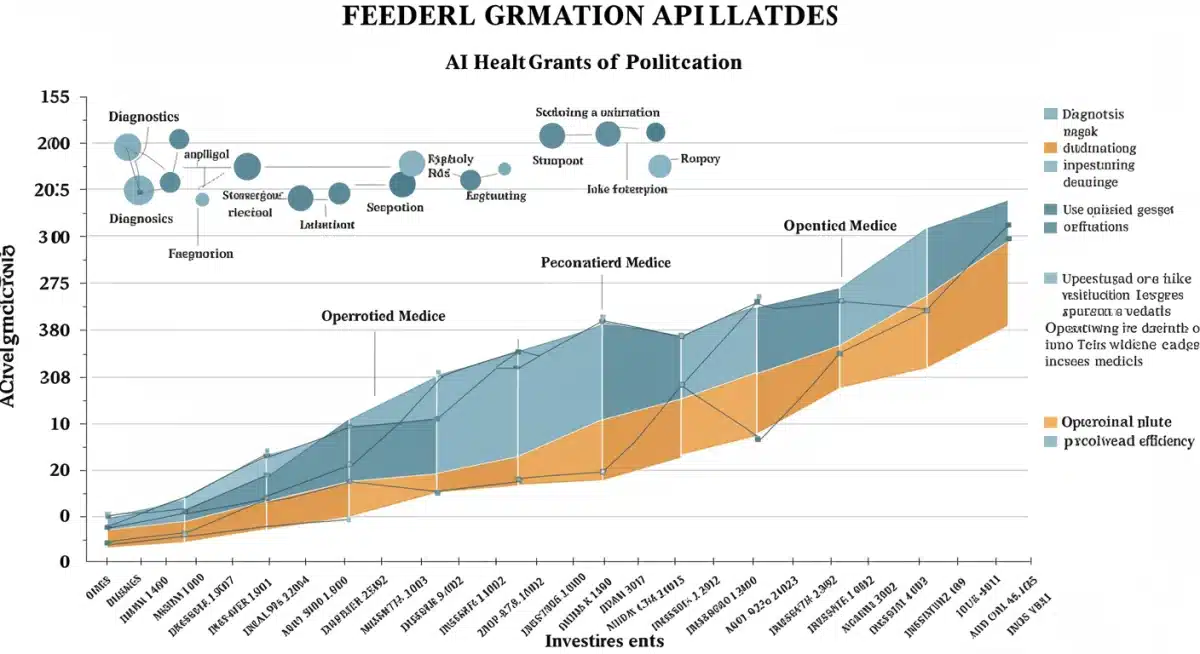
The Financial Impact: How 2026 Grants Will Reshape the Healthcare Economy
The financial ripple effects of this targeted AI healthcare funding will be profound and far-reaching. Beyond the direct allocation of funds, these grants will stimulate economic activity in several ways:
Boosting Research & Development (R&D) and Innovation Ecosystems
Federal grants are often the lifeblood of academic research and early-stage startups. The 2026 funding will significantly boost R&D efforts in universities, national laboratories, and nascent AI companies. This will lead to a proliferation of new technologies, patents, and scientific discoveries. It will also foster the growth of regional innovation hubs, creating jobs for AI scientists, engineers, data analysts, and clinical researchers. The initial investment acts as a magnet, attracting further private venture capital and fostering a vibrant ecosystem of innovation.
Driving Down Healthcare Costs in the Long Run
While the initial investment in AI is substantial, the long-term potential for cost savings in healthcare is immense. By improving diagnostic accuracy, preventing diseases, personalizing treatments, and optimizing operations, AI can reduce the need for expensive interventions, shorten hospital stays, and minimize waste. For example, AI-powered predictive analytics can identify patients at high risk of readmission, allowing for proactive interventions that save millions. Similarly, streamlined drug discovery processes can reduce the cost of bringing new medications to market, eventually translating into lower drug prices. The 2026 AI healthcare funding is an investment in a more efficient and sustainable healthcare system.
Creating New Markets and Job Opportunities
The widespread adoption of AI in healthcare will inevitably lead to the creation of entirely new markets and industries. Companies specializing in AI software development, data management, AI ethics consulting, and AI-driven medical device manufacturing will emerge and expand. This will generate a significant number of new, high-skilled jobs, requiring a workforce trained in both AI and healthcare domains. Educational institutions will also adapt, offering specialized programs to meet this demand, further strengthening the innovation pipeline.
Enhancing Global Competitiveness and Health Security
By investing heavily in domestic AI capabilities, the federal government aims to secure a leading position in the global AI race. This not only has economic benefits but also enhances national health security. A robust domestic AI healthcare sector makes a nation less reliant on foreign technologies and expertise, particularly during global health crises. It also positions the country as an attractive partner for international collaborations, further accelerating scientific progress.
Challenges and Considerations for Effective AI Healthcare Funding
While the prospects are exciting, maximizing the impact of 2026 AI healthcare funding requires careful consideration of several challenges:
- Data Privacy and Security: AI models thrive on data, and healthcare data is among the most sensitive. Ensuring robust privacy protections and cybersecurity measures is paramount. Grants must prioritize projects that incorporate privacy-preserving AI techniques and adhere to strict regulatory compliance (e.g., HIPAA).
- Regulatory Frameworks: The rapid pace of AI innovation often outstrips the development of regulatory frameworks. Clear guidelines are needed for the validation, deployment, and oversight of AI-powered medical devices and software. Funding should support research into effective regulatory science.
- Ethical Implications and Bias: AI algorithms can perpetuate or even amplify existing biases present in training data, leading to unfair or inequitable outcomes. Grants must explicitly address the development of fair, transparent, and interpretable AI systems, with a focus on mitigating bias across diverse patient populations.
- Workforce Development and Training: The successful integration of AI requires a healthcare workforce that is proficient in using these new tools. Funding will need to support training programs for clinicians, nurses, and administrators, as well as foster collaboration between AI experts and medical professionals.
- Interoperability and Integration: Healthcare systems are often fragmented, with disparate data sources and legacy IT infrastructure. AI solutions need to be interoperable and seamlessly integrate into existing workflows to achieve widespread adoption. Grants should encourage open standards and scalable integration strategies.
- Sustainability and Scalability: Initial funding is crucial, but long-term sustainability and scalability of AI solutions are equally important. Grants should consider projects with clear pathways to commercialization or sustainable adoption within healthcare systems post-grant period.
Best Practices for Grant Applicants and Recipients
For researchers, institutions, and companies looking to secure a portion of the 2026 AI healthcare funding, adhering to best practices will be critical:
- Focus on Clinical Need and Impact: Proposals should clearly articulate a significant unmet clinical need and demonstrate how the proposed AI solution will deliver tangible improvements in patient outcomes, efficiency, or access to care.
- Interdisciplinary Collaboration: Strong applications will showcase robust collaboration between AI experts, clinicians, data scientists, ethicists, and health economists. A holistic approach is often favored.
- Data Strategy and Governance: A clear plan for data acquisition, management, privacy, and security is essential. Demonstrating access to relevant, high-quality datasets and a sound data governance strategy will strengthen any application.
- Scalability and Commercialization Potential: Even for research grants, outlining a vision for how the technology could be scaled and eventually integrated into routine clinical practice, or commercialized, can be a significant advantage.
- Ethical Considerations: Proactively addressing potential ethical challenges, biases, and a plan for responsible AI development and deployment will be crucial.
- Measurable Outcomes: Clearly defined and measurable success metrics that align with the grant’s objectives are vital for demonstrating accountability and impact.

Looking Beyond 2026: The Long-Term Vision for AI in Healthcare
The 2026 federal grants represent a significant milestone, but they are part of a larger, ongoing commitment to harnessing AI for health. The long-term vision extends to a future where AI is not just a tool but an integral partner in every facet of healthcare:
- Proactive and Preventative Care: AI will shift healthcare from a reactive model (treating illness) to a proactive, preventative one (maintaining wellness). Continuous monitoring via wearables, predictive analytics, and personalized health recommendations will become commonplace.
- Equitable Access: AI can help democratize access to high-quality care, especially in underserved regions. Telemedicine enhanced by AI, remote diagnostics, and AI-powered educational tools can bridge geographical and socioeconomic gaps.
- Enhanced Human-AI Collaboration: The future isn’t about replacing humans but augmenting their capabilities. AI will empower clinicians with better insights, reduce burnout by automating routine tasks, and allow them to focus more on complex decision-making and empathetic patient interaction.
- Accelerated Scientific Discovery: AI will continue to accelerate the pace of scientific discovery, leading to breakthroughs in understanding complex diseases, developing novel therapies, and ultimately extending healthy human lifespans.
- Personalized Health Journeys: Each individual’s health journey will be uniquely tailored by AI, from personalized nutrition and exercise plans to bespoke treatment regimens and continuous health optimization.
The strategic deployment of AI healthcare funding in 2026 is therefore not just about immediate innovation; it’s about laying the groundwork for this transformative future. It’s an investment in a healthcare system that is more intelligent, efficient, equitable, and ultimately, more human-centric.
Conclusion: A New Era of Healthcare Powered by Federal Investment
The commitment to substantial federal funding for AI in healthcare, particularly the grants earmarked for 2026, signals a definitive shift in how nations approach health innovation. This strategic investment is poised to unlock unprecedented potential, driving advancements in precision medicine, drug discovery, diagnostics, and operational efficiency. The financial impact will resonate across the economy, fostering R&D, creating jobs, and potentially yielding significant long-term cost savings within the healthcare system.
However, the success of these initiatives hinges on a thoughtful approach that prioritizes ethical considerations, data security, regulatory clarity, and workforce development. By strategically directing this AI healthcare funding, governments are not just investing in technology; they are investing in a healthier, more resilient, and more equitable future for all. Stakeholders across the healthcare spectrum must prepare to leverage these opportunities, collaborate effectively, and contribute to building a future where AI serves as a powerful ally in the pursuit of optimal health and well-being.