Telehealth Reimbursement 2026: MedTech Growth & Policy Shifts

The Telehealth Reimbursement Landscape for MedTech Startups in 2026: A 15% Growth Opportunity Analysis
The healthcare industry is in a perpetual state of evolution, driven by technological advancements, demographic shifts, and changing patient expectations. Among the most transformative forces in recent years has been telehealth. Once a niche service, telehealth experienced an unprecedented surge during the COVID-19 pandemic, cementing its role as a critical component of modern healthcare delivery. As we look towards 2026, the Telehealth Reimbursement MedTech landscape continues to evolve, presenting both formidable challenges and significant opportunities, particularly for innovative MedTech startups. Industry analysts project a remarkable 15% growth opportunity in this sector, primarily fueled by expanding reimbursement policies and technological innovation.
For MedTech startups, understanding the intricacies of telehealth reimbursement is not merely an administrative task; it is a strategic imperative. The ability to navigate complex payment models, anticipate policy shifts, and demonstrate clinical and economic value directly impacts market access, revenue generation, and ultimately, long-term sustainability. This comprehensive analysis delves into the current state of telehealth reimbursement, recent updates, financial implications, and actionable strategies for MedTech companies aiming to capitalize on the projected growth by 2026.
The Foundation of Telehealth Reimbursement: A Shifting Paradigm
Before the pandemic, telehealth reimbursement was fragmented and often restrictive. Policies varied significantly by state, payer, and service type, creating a labyrinthine system that hindered widespread adoption. The public health emergency (PHE) declared in response to COVID-19 acted as a catalyst, prompting federal and state governments, along with private payers, to rapidly expand telehealth coverage and payment parity. Many of these temporary flexibilities have since been made permanent or extended, signaling a long-term commitment to integrating telehealth into the standard care continuum.
The core of Telehealth Reimbursement MedTech revolves around ensuring that virtual care services are compensated at rates comparable to in-person services, or at least at a level that incentivizes providers to adopt and utilize telehealth technologies. This parity is crucial for MedTech startups, whose innovations often rely on providers being able to bill for services delivered remotely using their devices or software. Without adequate reimbursement, even the most groundbreaking technologies struggle to gain traction.
Key Components of Telehealth Reimbursement:
- Provider Eligibility: Who can deliver telehealth services (e.g., physicians, nurses, therapists)?
- Patient Eligibility: What are the geographic or originating site requirements for patients? (Many of these were waived during the PHE and some remain waived).
- Service Type: Which specific services are reimbursable (e.g., virtual visits, remote patient monitoring, e-consults)?
- Technology Requirements: What platforms and security measures are mandated (e.g., HIPAA-compliant video conferencing)?
- Payment Parity: Are telehealth services reimbursed at the same rate as in-person services?
Understanding these foundational elements is the first step for any MedTech startup looking to embed its solutions within the telehealth ecosystem. As the landscape matures, these components are becoming more standardized, yet regional and payer-specific nuances persist.
Recent Updates and Policy Shifts Impacting MedTech in 2026
The period leading up to 2026 is marked by continued legislative and regulatory activity aimed at solidifying telehealth’s role. Several key areas are undergoing significant transformation:
1. Medicare & Medicaid Reimbursement Expansions:
The Centers for Medicare & Medicaid Services (CMS) has been at the forefront of telehealth expansion. Post-PHE, many of the expanded telehealth services under Medicare have been made permanent or extended. This includes allowing FQHCs and RHCs to serve as distant sites for mental health services, expanding the list of eligible telehealth practitioners, and maintaining payment for audio-only telehealth services in certain circumstances. For MedTech, this means a larger addressable market for solutions that support chronic disease management, behavioral health, and preventative care delivered virtually.
2. State-Level Mandates and Parity Laws:
While federal policies set a baseline, states play a crucial role in shaping the Telehealth Reimbursement MedTech environment. Many states have enacted permanent telehealth parity laws, requiring private payers to reimburse telehealth services at the same rate as in-person visits. These state mandates create a more predictable revenue stream for providers utilizing MedTech solutions, fostering greater adoption.
3. Focus on Remote Patient Monitoring (RPM) and Remote Therapeutic Monitoring (RTM):
RPM and RTM codes are particularly relevant for MedTech startups developing wearable devices, sensors, and digital platforms. CMS has expanded and clarified billing for these services, recognizing their value in managing chronic conditions and improving patient outcomes. The ability to bill for device setup, data transmission, and clinical review of data provides a clear pathway for MedTech companies to generate revenue through their technology and associated services.
4. Digital Therapeutics (DTx) Integration:
Digital therapeutics, which deliver evidence-based therapeutic interventions to patients using high-quality software programs, are gaining increasing recognition. While reimbursement for DTx is still evolving, there’s growing momentum to integrate these solutions into existing payment pathways. The FDA’s increasing clearance of DTx products, coupled with payer interest in outcomes-based models, suggests a fertile ground for MedTech startups in this space by 2026.
5. Interstate Licensure and Cross-State Practice:
One of the persistent challenges for telehealth has been provider licensure across state lines. While progress has been made through initiatives like the Interstate Medical Licensure Compact, full federal solutions are still pending. MedTech companies need to be aware of these limitations as they develop strategies for national or multi-state deployment of their telehealth-enabled solutions.
Financial Impact and the 15% Growth Opportunity
The projected 15% growth opportunity in the Telehealth Reimbursement MedTech sector by 2026 is not merely a statistical projection; it represents a tangible shift in investment, market penetration, and revenue potential. This growth is driven by several factors:
- Increased Provider Adoption: As reimbursement becomes more stable and predictable, more healthcare providers are integrating telehealth into their daily practice, creating a larger demand for MedTech tools that facilitate virtual care.
- Patient Demand: Patients have grown accustomed to the convenience and accessibility of telehealth, driving sustained demand for virtual services and the technologies that power them.
- Value-Based Care Models: Telehealth, particularly RPM and DTx, aligns perfectly with value-based care initiatives by improving outcomes, reducing hospitalizations, and lowering overall healthcare costs. Payers are increasingly incentivized to cover services that demonstrate such value.
- Technological Innovation: MedTech startups are continually developing more sophisticated devices and software, from AI-powered diagnostic tools to immersive virtual reality therapies, all of which require robust reimbursement pathways to succeed.
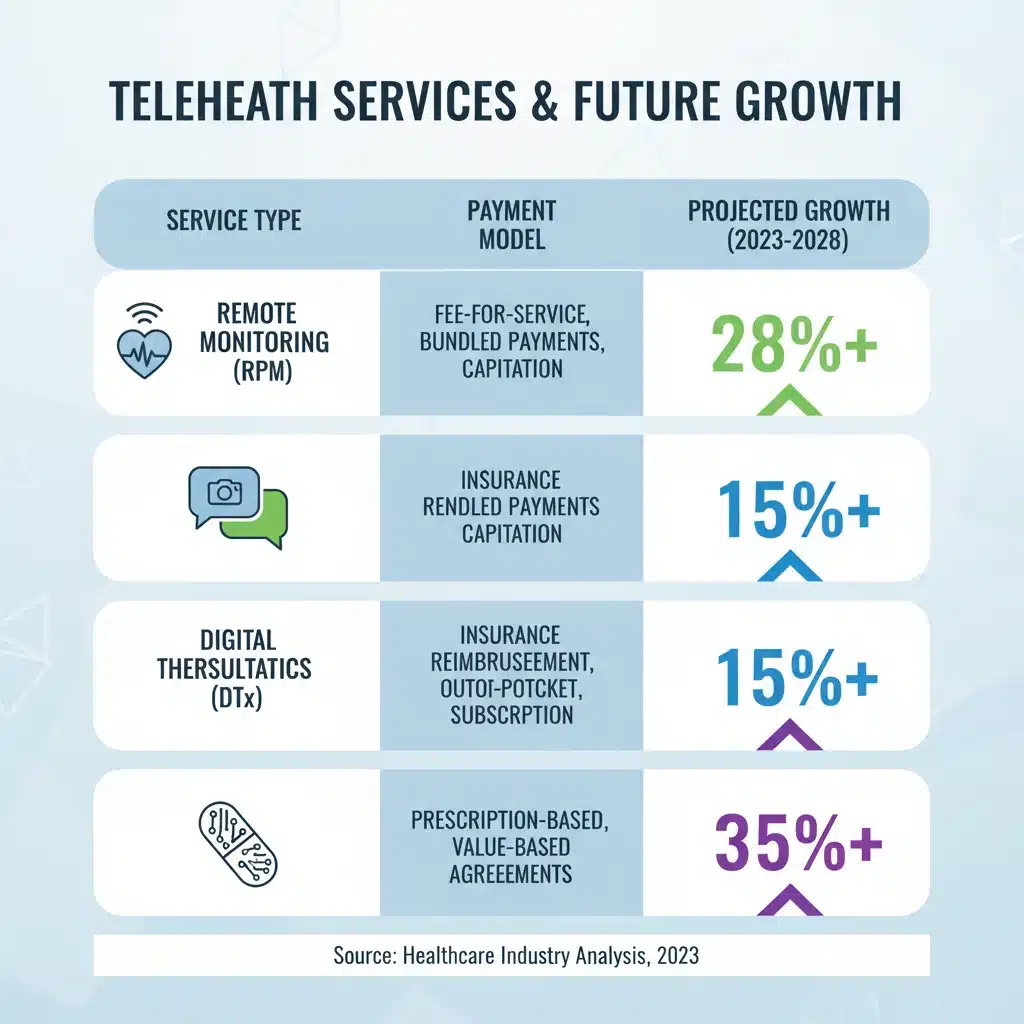
Revenue Generation for MedTech Startups:
- Direct Reimbursement for Devices/Software: In some cases, specific MedTech devices or software platforms may become directly reimbursable, particularly for chronic disease management or diagnostic purposes.
- Enabling Provider Reimbursement: The most common model involves MedTech solutions enabling providers to bill for telehealth services. Startups can offer their technology on a subscription basis to providers, charging for licenses, data analytics, or technical support.
- Outcomes-Based Payments: As value-based care matures, MedTech companies may explore models where their payment is tied to demonstrated improvements in patient outcomes or cost savings achieved through their technology.
- Data Monetization (with strict privacy controls): Aggregated and anonymized data collected through MedTech devices can offer valuable insights for research, public health, and product development, creating potential for ethical data monetization.
The 15% growth projection underscores the urgency for MedTech startups to strategically position themselves within this evolving financial ecosystem. Those that can effectively articulate their value proposition in terms of improved patient care and demonstrable cost savings will be best poised to capture this growth.
Navigating the Regulatory Labyrinth: Compliance and Strategy
While the reimbursement landscape offers significant opportunities, it remains complex and heavily regulated. MedTech startups must prioritize compliance and adopt a proactive regulatory strategy.
Key Regulatory Considerations:
- HIPAA Compliance: Ensuring the security and privacy of protected health information (PHI) is paramount. All telehealth platforms and devices must adhere to stringent HIPAA regulations.
- FDA Clearance/Approval: Depending on the device’s classification and intended use, FDA clearance or approval may be required. MedTech startups must understand the regulatory pathway for their specific product.
- State-Specific Regulations: Beyond federal guidelines, each state may have unique regulations regarding telehealth practice, consent requirements, and prescribing rules.
- Billing and Coding Compliance: Accurate billing and coding are essential to avoid denials and audits. MedTech companies should ensure their solutions support correct CPT/HCPCS codes and modifiers for telehealth services.
- Anti-Kickback Statute (AKS) & Stark Law: Relationships with providers must be structured carefully to avoid violating federal fraud and abuse laws.
A robust compliance framework is not just a safeguard against penalties; it also builds trust with providers and payers, facilitating smoother adoption and reimbursement processes. MedTech startups should consider engaging legal and regulatory experts early in their development cycle.
Strategic Imperatives for MedTech Startups by 2026
To successfully leverage the 15% growth opportunity in Telehealth Reimbursement MedTech, startups must adopt a multi-faceted strategic approach:
1. Demonstrate Clinical and Economic Value:
Payers are increasingly focused on value. MedTech startups must invest in robust clinical trials and real-world evidence studies to demonstrate that their telehealth-enabled solutions improve patient outcomes, reduce healthcare costs, and enhance efficiency. This evidence is crucial for advocating for favorable reimbursement policies and securing private payer coverage.
2. Understand Payer-Specific Policies:
While federal and state policies provide a framework, private payers often have their own specific guidelines for telehealth reimbursement. Startups need to research and understand the policies of key commercial insurers relevant to their target market. This may involve direct engagement with payers to educate them about the benefits of their technology.
3. Integrate Seamlessly into Clinical Workflows:
Providers are more likely to adopt technologies that are easy to use and integrate seamlessly into their existing electronic health record (EHR) systems. MedTech solutions that reduce administrative burden and enhance clinical efficiency will have a significant competitive advantage. This includes providing clear guidance on billing and coding within the platform.
4. Focus on Underserved Areas and Chronic Disease Management:
Telehealth has proven particularly effective in expanding access to care for rural populations and managing chronic conditions. MedTech solutions that address these critical needs are likely to find stronger support for reimbursement, as they align with public health priorities and demonstrate clear societal benefit.
5. Build Strategic Partnerships:
Collaborating with established healthcare systems, provider networks, and even other MedTech companies can accelerate market penetration and de-risk the reimbursement process. Partnerships can provide access to existing patient populations, clinical expertise, and established billing infrastructures.
6. Advocate for Policy Changes:
MedTech startups should actively participate in industry associations and advocacy groups to influence future telehealth reimbursement policies. A collective voice can be powerful in shaping legislation and regulations that are favorable to innovation.

Challenges and Mitigation Strategies
Despite the optimistic outlook, several challenges persist in the Telehealth Reimbursement MedTech landscape:
- Inconsistent State Laws: Variations in state laws regarding licensure, scope of practice, and reimbursement can create barriers to scaling telehealth solutions nationally.
- Technological Infrastructure Gaps: Unequal access to broadband internet, particularly in rural areas, can limit the reach of certain telehealth services.
- Cybersecurity Risks: The increased reliance on digital platforms elevates cybersecurity risks, requiring continuous investment in robust security measures.
- Provider Burnout and Training: Healthcare providers may experience burnout from adapting to new technologies and workflows, necessitating adequate training and support.
- Data Interoperability: Ensuring seamless data exchange between different MedTech devices, EHRs, and telehealth platforms remains a significant challenge.
Mitigation Strategies:
- Regional Focus: Initially target states with favorable and consistent telehealth policies.
- Offline Capabilities: Develop solutions that can function with limited connectivity or store-and-forward options.
- Advanced Security Protocols: Implement multi-layered security, end-to-end encryption, and regular security audits.
- User-Friendly Design & Training: Prioritize intuitive user interfaces and provide comprehensive training and ongoing support for providers.
- Standardized APIs: Advocate for and develop solutions that utilize standardized APIs for better interoperability.
The Future of Telehealth and MedTech Beyond 2026
Looking beyond 2026, the trajectory for telehealth and MedTech is one of continued integration and innovation. We can anticipate:
- Further Specialization: Telehealth will continue to expand into highly specialized areas, supported by advanced MedTech devices for diagnostics, monitoring, and even remote interventions.
- AI and Machine Learning Integration: AI will play an increasingly prominent role in analyzing telehealth data, predicting patient risks, and personalizing care plans, further enhancing the value proposition of MedTech solutions.
- Global Expansion: As reimbursement models mature in developed nations, there will be growing opportunities for MedTech startups to expand their telehealth solutions into international markets, adapting to diverse regulatory and payment environments.
- Preventative Care Focus: Telehealth, powered by MedTech, will be instrumental in shifting healthcare towards proactive and preventative models, reducing the burden of chronic diseases.
- Enhanced Patient Engagement: Gamification, personalized feedback, and social support features within MedTech apps will drive higher patient engagement and adherence to treatment plans.
The synergy between telehealth and MedTech is undeniable. As reimbursement policies solidify and expand, the ecosystem becomes more fertile for innovation. MedTech startups that are agile, compliant, and focused on delivering demonstrable value will be the ones to capture the projected 15% growth and shape the future of healthcare.
Conclusion
The Telehealth Reimbursement MedTech landscape in 2026 represents a pivotal moment for healthcare innovation. The significant policy shifts since the pandemic, coupled with a growing emphasis on value-based care, have opened up a substantial 15% growth opportunity for MedTech startups. Navigating this dynamic environment requires a deep understanding of evolving reimbursement models, a commitment to regulatory compliance, and a strategic focus on demonstrating both clinical efficacy and economic value.
For MedTech entrepreneurs, the path forward involves relentless innovation, strategic partnerships, and a proactive approach to engaging with payers and policymakers. By focusing on solutions that seamlessly integrate into clinical workflows, address critical healthcare needs, and provide clear benefits for patients and providers alike, startups can not only secure their financial future but also play a transformative role in making healthcare more accessible, efficient, and effective for all. The future of healthcare is undeniably digital, and MedTech startups are at the vanguard of this exciting revolution.