AI-Powered Predictive Analytics: Revolutionizing Hospital Readmission Prevention

In the intricate and often challenging landscape of US healthcare, one of the most persistent and costly issues is hospital readmissions. For decades, healthcare providers have grappled with the complex factors that lead patients back through their doors shortly after discharge. Not only do these readmissions represent a significant financial burden on the healthcare system, but more importantly, they often indicate suboptimal patient outcomes, a lack of continuity in care, and immense stress for patients and their families. The Centers for Medicare & Medicaid Services (CMS) has long recognized this problem, implementing initiatives like the Hospital Readmissions Reduction Program (HRRP) to incentivize hospitals to improve care coordination and reduce avoidable readmissions. While these efforts have yielded some progress, a truly transformative solution has remained elusive – until now. Enter AI hospital readmission prevention, a groundbreaking approach poised to reshape the future of patient care.
Artificial Intelligence (AI) and its powerful subset, predictive analytics, are no longer confined to the realms of science fiction. They are rapidly becoming indispensable tools across various industries, and healthcare is proving to be one of the most impactful beneficiaries. The ability of AI to process vast amounts of data, identify complex patterns, and generate accurate forecasts is uniquely suited to address the multifaceted challenge of hospital readmissions. By leveraging AI-powered predictive analytics, US healthcare systems are on the cusp of achieving a monumental goal: reducing hospital readmissions by an ambitious 15% by 2026. This isn’t just an optimistic projection; it’s a tangible, achievable target that promises to revolutionize patient care, optimize resource allocation, and enhance the overall efficiency of the healthcare ecosystem.
The Unseen Burden: Why Hospital Readmissions Matter
Before delving into the specifics of how AI hospital readmission prevention works, it’s crucial to understand the profound impact of this issue. Hospital readmissions are defined as a patient returning to the hospital within a specific timeframe, typically 30 days, after being discharged. The reasons for readmission are diverse, ranging from complications of the initial illness, inadequate post-discharge care, poor medication adherence, lack of social support, to new health issues. Regardless of the cause, the consequences are far-reaching.
Financial Strain on the Healthcare System
From a financial perspective, hospital readmissions represent billions of dollars in avoidable costs annually. CMS penalties for high readmission rates can significantly impact a hospital’s bottom line, forcing institutions to divert resources that could otherwise be used for improving facilities, technology, or staffing. These costs are ultimately borne by patients, insurers, and taxpayers. Reducing readmissions directly translates into substantial cost savings, freeing up resources to invest in preventative care and long-term health management strategies.
Impact on Patient Outcomes and Quality of Life
Beyond the financial implications, the human cost of readmissions is immense. Each readmission can be a traumatic experience for patients, leading to increased physical discomfort, emotional distress, and a deterioration in their quality of life. Repeated hospital stays disrupt personal lives, employment, and social connections. Furthermore, readmissions often expose vulnerable patients to additional risks, including hospital-acquired infections and adverse drug events. Improving readmission rates is not just about saving money; it’s fundamentally about providing better, safer, and more compassionate care to patients when they need it most. This is where the power of AI hospital readmission prevention truly shines, offering a proactive rather than reactive approach to patient well-being.
The Role of CMS and Regulatory Pressure
The HRRP, enacted as part of the Affordable Care Act (ACA), has placed significant pressure on hospitals to reduce readmissions. Hospitals with higher-than-expected readmission rates for specific conditions (e.g., heart failure, pneumonia, acute myocardial infarction) face financial penalties. This regulatory environment has spurred a concerted effort within healthcare institutions to find effective strategies for readmission reduction. While traditional methods have had some success, the scale and complexity of the problem demand more sophisticated, data-driven solutions, leading many to explore AI hospital readmission strategies.
The Dawn of AI-Powered Predictive Analytics in Healthcare
Predictive analytics, at its core, involves using statistical algorithms and machine learning techniques to analyze historical data and make predictions about future outcomes. In healthcare, this translates to crunching vast datasets – including electronic health records (EHRs), claims data, demographic information, social determinants of health (SDOH), and even real-time physiological data from wearable devices – to identify patients at high risk of readmission. The sheer volume and complexity of this data make it impossible for human clinicians to process manually, highlighting the critical role of AI.
How AI Identifies At-Risk Patients
AI models are trained on historical patient data, learning to recognize patterns and correlations that precede readmission. For example, an AI model might identify that patients with a specific combination of chronic conditions, a particular medication regimen, a history of non-adherence, and living alone in a low-income area are significantly more likely to be readmitted. These are insights that might be missed by traditional risk assessment tools or human intuition alone. By continuously learning and refining its algorithms, AI can provide increasingly accurate and personalized risk scores for each patient. This proactive identification is the cornerstone of effective AI hospital readmission prevention.
Key Data Points Utilized by AI
The efficacy of AI in predicting readmissions hinges on the quality and breadth of the data it analyzes. Key data points often include:
- Clinical Data: Diagnoses, procedures, lab results, vital signs, medication history, allergies, and past medical history from EHRs.
- Demographic Data: Age, gender, ethnicity, marital status.
- Social Determinants of Health (SDOH): Socioeconomic status, access to transportation, housing stability, food security, social support networks. These factors are increasingly recognized as critical drivers of health outcomes and readmission risk.
- Behavioral Data: Adherence to medication schedules, follow-up appointment attendance, lifestyle choices (e.g., smoking, diet).
- Discharge Planning Information: Quality of discharge instructions, availability of home health services, post-discharge follow-up appointments.
By integrating and analyzing these diverse data streams, AI creates a holistic view of the patient, enabling more nuanced and accurate risk stratification. This comprehensive approach is what makes AI hospital readmission strategies so powerful.
Implementation Strategies for AI-Powered Readmission Reduction
The successful integration of AI-powered predictive analytics into existing healthcare workflows requires careful planning and strategic execution. It’s not simply about deploying a new technology; it’s about transforming care delivery processes and fostering a data-driven culture.
Integrating AI into Electronic Health Records (EHRs)
For AI to be truly effective, it must be seamlessly integrated into the clinician’s workflow. This means embedding predictive risk scores and alerts directly within the EHR system. When a patient is admitted, or nearing discharge, the AI system should automatically generate a readmission risk score, flagging high-risk individuals for immediate intervention. This integration ensures that clinicians have real-time, actionable insights at their fingertips, enabling them to make informed decisions without additional administrative burden.
Developing Targeted Intervention Programs
Once high-risk patients are identified, the next critical step is to implement targeted intervention programs. These programs are tailored to address the specific risk factors identified by the AI. Examples include:
- Intensified Discharge Planning: For patients at high risk due to social determinants of health, this might involve connecting them with social workers, transportation services, or food assistance programs.
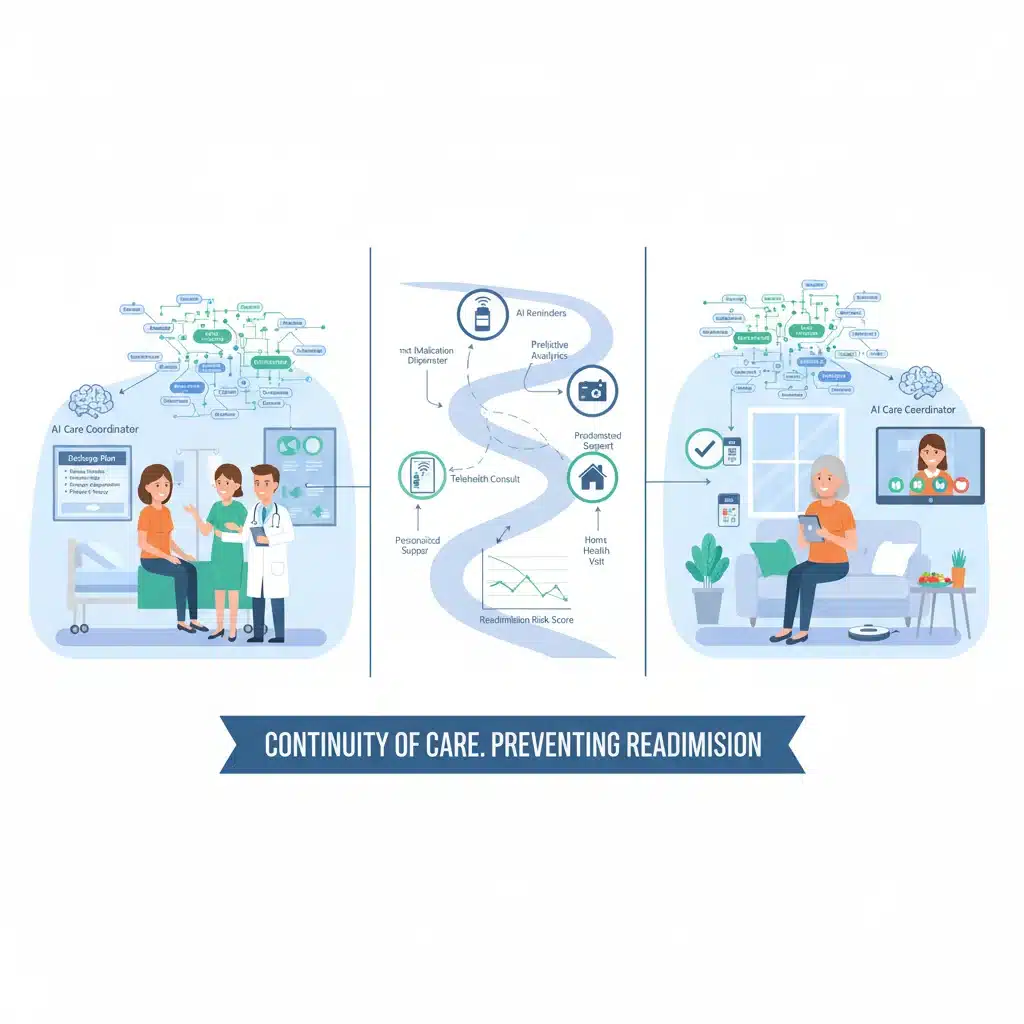
- Enhanced Post-Discharge Follow-up: This could include more frequent telehealth check-ins, home health visits, or dedicated nurse navigators to ensure medication adherence and understanding of discharge instructions.
- Patient Education: Providing clear, personalized education materials about their condition, medications, and warning signs of complications.
- Care Coordination: Ensuring seamless handoffs between hospitalists, primary care physicians, specialists, and community resources.
- Remote Patient Monitoring: Utilizing wearable devices or in-home sensors to continuously track vital signs and alert care teams to early signs of deterioration.
The beauty of AI hospital readmission prevention lies in its ability to move beyond a one-size-fits-all approach, enabling highly personalized and effective interventions.

Overcoming Implementation Challenges
While the potential of AI is immense, its implementation is not without challenges. These include:
- Data Silos and Interoperability: Healthcare data is often fragmented across different systems, making it difficult to create a comprehensive dataset for AI training.
- Data Quality: Inaccurate or incomplete data can lead to biased or unreliable AI predictions.
- Clinician Buy-in: Healthcare professionals need to understand and trust AI tools. Proper training and demonstrating tangible benefits are crucial.
- Ethical Considerations: Ensuring fairness, transparency, and privacy in AI algorithms, particularly when dealing with sensitive patient data.
- Resource Allocation: Investing in the necessary infrastructure, talent (data scientists, AI engineers), and ongoing maintenance.
Addressing these challenges proactively is key to unlocking the full potential of AI hospital readmission solutions.
Case Studies and Success Stories: Real-World Impact
While the goal of a 15% reduction by 2026 is ambitious, early adopters of AI hospital readmission prevention are already demonstrating significant success. Numerous healthcare systems across the US have piloted and implemented AI solutions, reporting impressive results.
Leading the Charge: Examples of AI in Action
One prominent example involves a large academic medical center that implemented an AI model to predict readmission risk for heart failure patients. By combining clinical data with social determinants of health, the model accurately identified high-risk individuals, allowing care teams to deploy targeted interventions such as enhanced patient education, home health referrals, and social work consultations. Within a year, this hospital reported a 12% reduction in 30-day readmissions for this specific patient population, leading to substantial cost savings and improved patient outcomes.
Another healthcare network utilized AI to analyze discharge summaries and identify patients likely to miss follow-up appointments. By proactively reaching out to these patients, providing transportation assistance, and offering flexible scheduling, they saw a significant increase in follow-up adherence and a corresponding drop in readmission rates across several chronic conditions. These success stories underscore the practical efficacy of AI hospital readmission strategies.
Quantifiable Benefits: Beyond Just Numbers
The benefits of these initiatives extend beyond mere statistics. They translate into:
- Improved Patient Satisfaction: Patients feel more supported and confident in their post-discharge care.
- Reduced Clinician Burnout: By automating risk assessment and streamlining intervention planning, AI can free up clinicians to focus on direct patient care.
- Better Resource Utilization: Hospitals can allocate resources more effectively, focusing intensive interventions on those who need them most.
- Enhanced Reputation: Hospitals with lower readmission rates are often viewed as providing higher quality care, attracting more patients and talent.
These tangible improvements solidify the argument for widespread adoption of AI hospital readmission solutions.
The Future of AI in Hospital Readmission Prevention
The journey towards a 15% reduction in hospital readmissions by 2026 is an ambitious yet achievable goal, and AI-powered predictive analytics will be at the forefront of this transformation. The technology is continuously evolving, and future developments promise even greater accuracy and broader applicability.
Advancements in AI and Machine Learning
Future AI models will likely incorporate even more sophisticated techniques, such as deep learning and natural language processing (NLP), to extract insights from unstructured data within EHRs (e.g., physician notes, nursing assessments). The integration of real-time data from continuous monitoring devices and even environmental factors will further enhance predictive accuracy. Personalized risk assessment will become even more granular, allowing for truly individualized care plans. The continuous evolution of AI hospital readmission technologies ensures ongoing improvements.
Expanding the Scope: Beyond 30-Day Readmissions
While current efforts often focus on 30-day readmissions due to regulatory incentives, AI’s capabilities can extend to predicting longer-term adverse events, such as 90-day readmissions, emergency department visits, or even long-term functional decline. This broader scope will enable healthcare systems to implement preventative measures that support sustained patient health and well-being, moving towards a more holistic model of care.
The Role of Interoperability and Data Sharing
A key enabler for the future of AI in healthcare is improved data interoperability. As healthcare systems become better at sharing data securely and efficiently, AI models will have access to richer, more comprehensive datasets. This will not only improve the accuracy of predictions but also facilitate a more coordinated approach to patient care across different providers and settings, a crucial element for effective AI hospital readmission prevention.
Ethical AI and Human Oversight
As AI becomes more ingrained in healthcare decision-making, the importance of ethical AI and human oversight will only grow. Ensuring that AI algorithms are fair, unbiased, and transparent is paramount. Clinicians will remain central to the care process, using AI as an intelligent assistant to augment their capabilities, not replace their judgment. The synergy between human expertise and AI intelligence will be the driving force behind achieving the ambitious goal of reducing readmissions. This collaborative approach is essential for successful AI hospital readmission initiatives.
Conclusion: A Healthier Future Driven by AI
The challenge of hospital readmissions has long vexed the US healthcare system, imposing significant financial burdens and compromising patient well-being. However, the advent of AI hospital readmission prevention, powered by sophisticated predictive analytics, offers a powerful and transformative solution. By harnessing the ability of AI to analyze vast datasets, identify complex risk factors, and predict future outcomes, healthcare providers can move from a reactive model of care to a proactive, preventative one.
The ambitious target of reducing hospital readmissions by 15% in US healthcare systems by 2026 is not merely a statistical goal; it represents a profound shift towards a more efficient, equitable, and patient-centered healthcare landscape. This reduction will translate into billions of dollars saved, which can be reinvested into improving care quality, expanding access, and fostering innovation. More importantly, it will mean healthier lives for countless patients, fewer traumatic hospital stays, and a greater sense of security for families navigating the complexities of illness.
While challenges in data integration, clinician adoption, and ethical considerations remain, the undeniable benefits and the rapid pace of technological advancement suggest that these hurdles are surmountable. The future of healthcare is inextricably linked with AI, and its role in preventing hospital readmissions is a testament to its profound potential. As healthcare systems continue to embrace and refine these intelligent solutions, we can look forward to a future where hospital readmissions are the exception, not the rule, leading to a healthier, more sustainable healthcare system for all. The era of intelligent, preventative care, driven by AI hospital readmission strategies, has truly begun.