HIPAA Compliance for Telehealth MedTech Startups by 2026

Achieving HIPAA compliance telehealth 2026 for new MedTech startups is paramount, requiring a comprehensive strategy to safeguard patient data and navigate evolving regulatory landscapes proactively.
For new telehealth MedTech startups, the mandate to achieve HIPAA compliance telehealth 2026 is not merely a legal obligation but a cornerstone of building trust and ensuring sustainable growth in a rapidly evolving digital health landscape. The January 2026 deadline looms, making proactive and strategic planning an absolute necessity. Understanding the nuances of the Health Insurance Portability and Accountability Act (HIPAA) and its implications for virtual care platforms is crucial for any emerging company aiming to revolutionize healthcare through technology.
Understanding HIPAA: The Foundation for Telehealth MedTech
HIPAA, enacted in 1996, established national standards to protect sensitive patient health information from being disclosed without the patient’s consent or knowledge. For telehealth MedTech startups, this means every facet of their operation, from data collection to storage and transmission, must adhere to these stringent regulations. The digital nature of telehealth introduces unique challenges and responsibilities that differ significantly from traditional healthcare settings.
The core of HIPAA compliance revolves around three primary rules: the Privacy Rule, the Security Rule, and the Breach Notification Rule. Each of these rules plays a critical role in how protected health information (PHI) is managed. Many startups initially underestimate the complexity of these regulations, leading to potential missteps that can result in significant penalties and irreparable damage to their reputation.
The Privacy Rule: Safeguarding Patient Information
The Privacy Rule sets national standards for the protection of individually identifiable health information by covered entities and their business associates. It gives patients rights over their health information, including rights to examine and obtain a copy of their health records and to request corrections. For telehealth platforms, this translates into meticulous consent management and transparent data handling practices.
- Obtaining explicit patient consent for data collection and use.
- Providing clear notices of privacy practices.
- Ensuring patient access to their health records.
- Implementing robust authorization processes for data sharing.
The Security Rule: Protecting Electronic PHI
The Security Rule specifies administrative, physical, and technical safeguards to protect electronic protected health information (ePHI). This is particularly relevant for telehealth MedTech startups, as their entire service delivery model relies on electronic systems. Compliance requires a multi-layered approach to security, addressing everything from network access to workstation security.
- Conducting regular security risk assessments.
- Implementing access controls and authentication protocols.
- Utilizing encryption for data in transit and at rest.
- Developing robust disaster recovery and data backup plans.
The January 2026 deadline emphasizes that these rules are not static; they are continuously interpreted and enforced with an increasing focus on emerging technologies. Startups must not only understand the current regulations but also anticipate future interpretations and potential amendments to ensure long-term compliance. This foresight is what distinguishes successful MedTech ventures from those that falter under regulatory pressure.
Phase 1: Initial Assessment and Gap Analysis (Q1-Q2 2025)
The journey towards HIPAA compliance telehealth 2026 begins with a thorough initial assessment and gap analysis. This crucial first phase involves understanding where your current operations stand in relation to HIPAA requirements and identifying any areas of non-compliance. It’s an internal audit that lays the groundwork for all subsequent compliance efforts.
Engaging a third-party expert or dedicating internal resources with deep HIPAA knowledge is highly recommended for this phase. Their expertise can help uncover subtle vulnerabilities that might be overlooked by an inexperienced team. The goal is to create a comprehensive snapshot of your current security posture and data handling practices.
Conducting a Comprehensive Risk Assessment
A risk assessment is not a one-time event but an ongoing process. Initially, it helps identify potential threats and vulnerabilities to ePHI. This includes evaluating all systems, applications, and processes that create, receive, maintain, or transmit ePHI. Understanding where the risks lie is the first step in mitigating them effectively.
- Mapping all data flows of ePHI within the organization.
- Identifying potential security threats and vulnerabilities.
- Assessing the likelihood and impact of identified risks.
- Documenting all findings and prioritizing areas for remediation.
Identifying Gaps and Developing a Remediation Plan
Once risks are identified, the next step is to pinpoint the specific gaps in your current practices and technology that lead to these risks. This might involve comparing your current state against HIPAA’s administrative, physical, and technical safeguards. A detailed remediation plan, complete with timelines and assigned responsibilities, should then be developed.
- Documenting all identified compliance gaps.
- Prioritizing gaps based on risk level and potential impact.
- Defining clear actions for each remediation task.
- Establishing a realistic timeline for implementation.
This phase is foundational. Rushing through it or making assumptions can lead to significant issues down the line. A meticulous and well-documented assessment provides the clarity needed to navigate the complex path to full HIPAA compliance, ensuring that your MedTech startup is built on a secure and legally sound footing well before the 2026 deadline.
Phase 2: Policy Development and Implementation (Q3-Q4 2025)
With a clear understanding of existing gaps, the next critical phase for achieving HIPAA compliance telehealth 2026 involves developing and implementing robust policies and procedures. This isn’t just about writing documents; it’s about embedding compliance into the operational DNA of your MedTech startup. Effective policies serve as the backbone of your security and privacy framework, guiding employee behavior and system configurations.
These policies must be comprehensive, covering all aspects of HIPAA’s Privacy, Security, and Breach Notification Rules. They should be clear, concise, and easily accessible to all employees, ensuring that everyone understands their role in protecting patient information. This phase also includes the crucial step of actually putting these policies into practice across all departments.
Crafting HIPAA-Compliant Policies and Procedures
Developing policies means translating regulatory requirements into actionable guidelines for your team. This includes creating documents for data access, incident response, remote work security, and business associate agreements. Each policy should clearly define responsibilities, procedures, and enforcement mechanisms to ensure consistent adherence.
- Developing a comprehensive privacy policy and notice of privacy practices.
- Establishing security policies for data encryption, access control, and audit trails.
- Creating a detailed incident response plan for data breaches.
- Drafting business associate agreements (BAAs) for all third-party vendors.
Implementing Technical and Physical Safeguards
Alongside policy development, the technical and physical safeguards identified in the risk assessment must be implemented. This involves configuring systems, deploying security tools, and securing physical access to ePHI. It’s where the theoretical aspects of compliance become tangible, protecting patient data through practical measures.
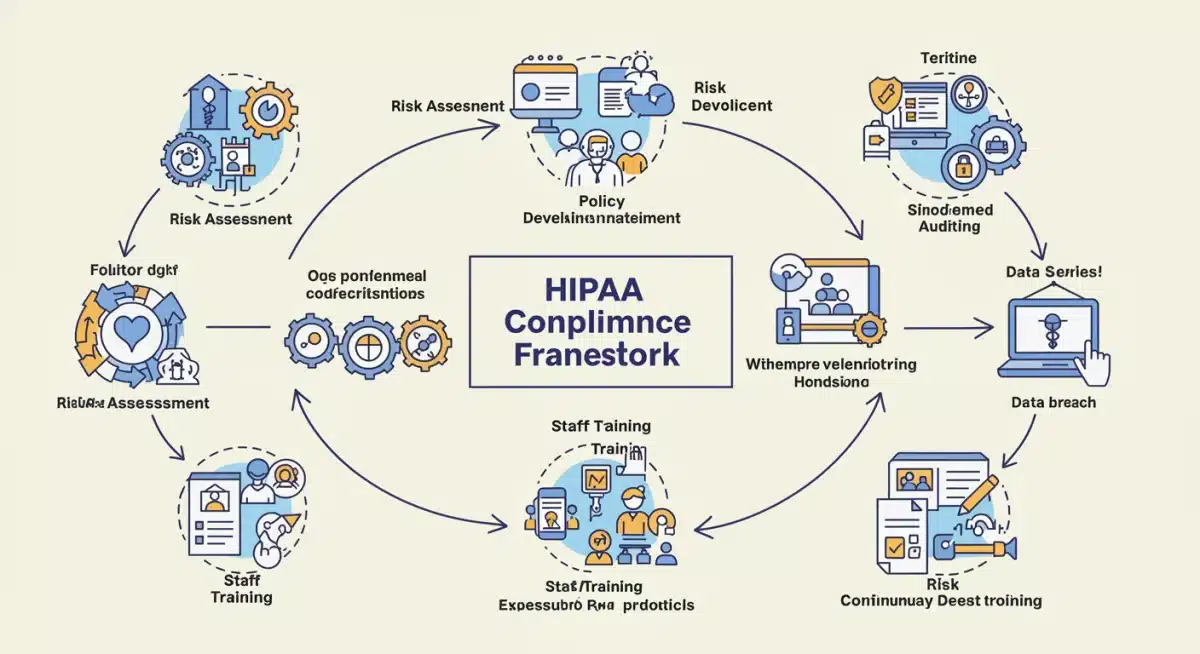
For telehealth, this might include secure video conferencing platforms, encrypted communication channels, and secure data storage solutions. Physical safeguards cover aspects like securing server rooms and ensuring proper disposal of electronic devices containing ePHI. The integrity of these safeguards is paramount to prevent unauthorized access or data loss.
This phase demands meticulous attention to detail and a commitment from leadership to allocate necessary resources. Policies are only as effective as their implementation. Regular reviews and updates will be necessary to ensure they remain relevant as your startup grows and technology evolves, reinforcing your dedication to HIPAA compliance as the 2026 deadline approaches.
Phase 3: Training and Awareness (Q4 2025 – Q1 2026)
Even the most robust policies and advanced security systems are ineffective without a well-informed and vigilant team. Therefore, a critical component of achieving HIPAA compliance telehealth 2026 is comprehensive training and ongoing awareness programs for all staff members. Human error remains a leading cause of data breaches, making education an indispensable safeguard.
Every individual within your MedTech startup, from developers to customer support and administrative staff, must understand their role in protecting protected health information (PHI). Training should not be a one-off event but a continuous process, adapting to new threats and regulatory updates. This commitment to ongoing education fosters a culture of security and privacy within the organization.
Developing a Comprehensive Training Program
A successful training program goes beyond simply explaining HIPAA rules; it should illustrate their practical application within the context of your startup’s operations. Use real-world scenarios and interactive modules to make the learning engaging and memorable. Tailor content to different roles, highlighting specific responsibilities related to PHI handling.
- Mandatory initial training for all new hires on HIPAA fundamentals.
- Regular refresher training sessions, at least annually.
- Specialized training for employees handling sensitive data or specific security roles.
- Testing and assessment to ensure comprehension and retention of key concepts.
Fostering a Culture of Security and Privacy
Beyond formal training, cultivating an organizational culture where security and privacy are paramount is essential. This involves consistent communication from leadership about the importance of HIPAA, recognizing employees who demonstrate exemplary compliance, and providing easy access to resources and support for privacy-related questions. A strong culture ensures that compliance is a shared responsibility, not just a departmental task.
Regular reminders through newsletters, posters, and internal communications can reinforce training messages. Encourage employees to report suspicious activities or potential vulnerabilities without fear of reprisal. This proactive approach helps identify and address issues before they escalate into significant incidents. By investing in your team’s knowledge and fostering a strong security culture, your MedTech startup significantly strengthens its position for HIPAA compliance telehealth 2026.
Phase 4: Ongoing Monitoring and Auditing (Post-January 2026)
Achieving HIPAA compliance telehealth 2026 is not a destination but a continuous journey. Even after the January 2026 deadline passes, new telehealth MedTech startups must establish robust systems for ongoing monitoring, internal auditing, and regular reassessment of their compliance posture. The regulatory landscape, technological threats, and operational practices are constantly evolving, demanding continuous vigilance.
This phase is about maintaining the integrity of your compliance framework and adapting to change. It demonstrates to regulators and patients alike that your commitment to protecting PHI is unwavering. Proactive monitoring helps identify potential issues before they become full-blown breaches, saving your startup from significant penalties and reputational damage.
Implementing Continuous Monitoring Systems
Continuous monitoring involves deploying tools and processes that actively track security events, data access, and system configurations. This includes intrusion detection systems, audit logs, and data loss prevention (DLP) solutions. Automated alerts can notify your security team of any unusual or suspicious activities in real time, enabling immediate investigation and response.
- Utilizing security information and event management (SIEM) systems.
- Regularly reviewing access logs for unauthorized attempts.
- Monitoring network traffic for anomalies and potential threats.
- Automating vulnerability scans and penetration testing.
Conducting Regular Internal and External Audits
Beyond continuous monitoring, scheduled internal and external audits are crucial for validating the effectiveness of your compliance program. Internal audits, conducted by your own team or an independent internal auditor, provide an objective assessment of your adherence to policies and procedures. External audits, often performed by third-party specialists, offer an unbiased perspective and can help identify blind spots.
These audits should review all aspects of your HIPAA compliance, from policy effectiveness to technical safeguards and employee training. The findings from these audits should inform necessary adjustments and improvements to your compliance program. This iterative process of monitoring, auditing, and refining ensures that your MedTech startup remains resilient against emerging threats and maintains its strong posture for HIPAA compliance telehealth 2026 and beyond.
Phase 5: Business Associate Management and Incident Response (Ongoing)
For telehealth MedTech startups, achieving and maintaining HIPAA compliance telehealth 2026 extends beyond internal operations to encompass relationships with third-party vendors and a robust incident response strategy. Many startups rely on various external services, from cloud hosting to analytics platforms, each of which can potentially access or process protected health information (PHI). Managing these relationships and preparing for the inevitable — a security incident — are ongoing, critical components of compliance.
Neglecting business associate agreements (BAAs) or having an underdeveloped incident response plan can expose your startup to significant risks, even if your internal controls are strong. These elements are not merely checkboxes; they are active, dynamic processes that require continuous attention and refinement.
Managing Business Associate Agreements (BAAs)
HIPAA mandates that covered entities (like your MedTech startup) enter into BAAs with any third-party service provider (Business Associate) that creates, receives, maintains, or transmits PHI on their behalf. A BAA legally obligates the business associate to protect PHI in accordance with HIPAA standards. Without a proper BAA, your startup could be held liable for a business associate’s breach.
- Identifying all vendors that qualify as Business Associates.
- Ensuring all BAAs are in place and legally sound.
- Regularly reviewing BAAs for compliance with current regulations.
- Conducting due diligence on potential business associates’ security practices.
Developing and Testing an Incident Response Plan
No matter how prepared you are, security incidents can occur. A well-defined and regularly tested incident response plan is crucial for mitigating the damage of a data breach and ensuring timely compliance with HIPAA’s Breach Notification Rule. This plan should detail the steps to take from detection to containment, eradication, recovery, and post-incident analysis.
For telehealth MedTech startups, the plan must address how ePHI breaches are handled, including notifying affected individuals, the Department of Health and Human Services (HHS), and potentially the media, within strict timelines. Regular drills and simulations are vital to ensure the team can execute the plan effectively under pressure. This preparedness is a testament to your commitment to HIPAA compliance telehealth 2026, safeguarding both patient data and your startup’s future.
The Future of Telehealth MedTech and Compliance (Beyond 2026)
As we move beyond January 2026, the landscape for telehealth MedTech startups will continue to evolve, with compliance remaining a dynamic and central challenge. The rapid pace of technological innovation, coupled with an increasing reliance on digital health solutions, means that HIPAA and related regulations will likely see further refinements. Staying ahead requires a forward-thinking approach, not just reacting to mandates but anticipating future needs.
The integration of artificial intelligence (AI) and machine learning (ML) into telehealth platforms, for example, introduces new complexities regarding data privacy and security. Startups must consider how these advanced technologies process PHI and ensure their implementations align with current and future regulatory expectations. This might involve exploring new privacy-enhancing technologies and ethical AI frameworks.
Anticipating Regulatory Changes and Technological Advancements
Regulators are constantly monitoring the healthcare technology sector. New guidelines or amendments to HIPAA may emerge to address novel data processing methods, cross-border data flows, or advanced cybersecurity threats. MedTech startups should actively engage with industry associations, regulatory bodies, and legal experts to stay informed about these potential shifts. Proactive engagement can even influence future policy, ensuring regulations are practical for innovation.
- Subscribing to regulatory updates from HHS and other relevant agencies.
- Participating in industry forums and working groups on health tech policy.
- Conducting periodic legal reviews of compliance practices.
- Investing in research and development for privacy-by-design technologies.
Building a Resilient and Trustworthy Telehealth Ecosystem
Ultimately, the goal of HIPAA compliance telehealth 2026 and beyond is to build a resilient and trustworthy telehealth ecosystem. For new MedTech startups, this means not only avoiding penalties but also fostering deep patient trust, which is invaluable in healthcare. A strong compliance posture enhances your market reputation, attracts investment, and facilitates partnerships, positioning your startup as a leader in secure and ethical digital health. This long-term vision for compliance is what transforms regulatory burdens into competitive advantages, ensuring sustained growth and impact in the evolving world of telehealth.
| Key Point | Brief Description |
|---|---|
| Initial Assessment | Conduct a thorough risk assessment and gap analysis to identify current compliance status and vulnerabilities. |
| Policy & Implementation | Develop and implement comprehensive HIPAA-compliant policies, procedures, and technical/physical safeguards. |
| Training & Awareness | Establish mandatory training programs and foster a strong culture of security and privacy among all staff. |
| Ongoing Vigilance | Implement continuous monitoring, regular audits, and robust incident response plans for sustained compliance. |
Frequently Asked Questions About HIPAA Compliance for Telehealth
The primary goal is to protect sensitive patient health information (PHI) from unauthorized access or disclosure, ensuring patient privacy and data security. Achieving compliance by January 2026 also establishes legal operational integrity and builds essential trust with patients and partners.
The January 2026 deadline underscores the urgency for all new telehealth MedTech startups to have robust HIPAA compliance frameworks fully operational. It signals increased regulatory scrutiny and the need for proactive, comprehensive strategies to align with federal standards, avoiding potential penalties and operational disruptions.
Telehealth startups must primarily address the HIPAA Privacy Rule (patient data rights), Security Rule (ePHI protection via administrative, physical, and technical safeguards), and Breach Notification Rule (protocol for security incidents). Comprehensive understanding and implementation of all three are vital.
Effective BAA management involves identifying all third-party vendors handling PHI, ensuring legally sound agreements are in place, and regularly reviewing them. Due diligence on a vendor’s security practices before engagement is crucial to mitigate shared compliance risks for your MedTech startup.
Employee training is fundamental. It ensures all staff understand their responsibilities in protecting PHI, reducing human error which is a significant cause of breaches. Ongoing, tailored training fosters a culture of security and privacy, making compliance a collective effort within the startup.
Conclusion
Achieving HIPAA compliance telehealth 2026 for new MedTech startups is an intricate yet indispensable endeavor. It demands a phased, strategic approach encompassing rigorous risk assessments, the development of comprehensive policies, continuous staff training, and vigilant ongoing monitoring. Beyond merely meeting a deadline, robust HIPAA compliance serves as the bedrock for building patient trust, ensuring data integrity, and fostering sustainable innovation within the dynamic telehealth sector. By embedding privacy and security into their core operations now, MedTech startups can not only navigate immediate regulatory demands but also lay a strong foundation for future growth and resilience in a rapidly evolving digital healthcare landscape.