AI Platforms for Drug Discovery: Fastest Time-to-Market in 2025?

A comprehensive comparative analysis of leading AI platforms for drug discovery in 2025 indicates that platforms leveraging advanced machine learning for target identification and lead optimization are best positioned to deliver the fastest time-to-market.
The landscape of pharmaceutical innovation is rapidly transforming, with artificial intelligence emerging as a pivotal force. A comparative analysis of leading AI platforms for drug discovery in 2025 is no longer a theoretical exercise but a critical assessment for companies aiming to drastically reduce the time and cost associated with bringing new treatments to patients. This shift promises to accelerate the journey from concept to clinic, offering hope for countless unmet medical needs.
The AI Revolution in Drug Discovery: A New Paradigm
The traditional drug discovery pipeline is notoriously long, expensive, and fraught with high failure rates. From initial target identification to preclinical testing and clinical trials, the process can take over a decade and cost billions of dollars. AI is fundamentally reshaping this paradigm by automating complex tasks, predicting molecular interactions with unprecedented accuracy, and identifying novel therapeutic candidates at a pace previously unimaginable.
This revolution is driven by advances in machine learning, deep learning, and computational biology, allowing AI platforms to analyze vast datasets including genomic information, proteomic structures, and patient health records. The integration of these technologies promises not only to speed up discovery but also to enhance the precision and efficacy of new drugs, leading to more targeted therapies and personalized medicine approaches.
Accelerating Target Identification and Validation
One of the earliest and most critical stages where AI significantly impacts time-to-market is in target identification and validation. Identifying the right biological targets for intervention is paramount, and AI algorithms can sift through massive biological databases to pinpoint promising candidates far more efficiently than human researchers alone.
- Genomic Data Analysis: AI excels at analyzing large genomic datasets to identify disease-associated genes and pathways.
- Proteomic Structure Prediction: Advanced AI models can predict complex protein structures, crucial for understanding drug binding.
- Phenotypic Screening: AI algorithms can analyze high-throughput screening data to identify compounds with desired biological activity.
By leveraging AI, researchers can quickly prioritize targets with the highest likelihood of success, thereby reducing the time spent on less viable avenues. This early-stage acceleration sets the foundation for a faster overall drug development timeline.
In conclusion, the transformative power of AI in drug discovery begins at the very initial stages, offering a robust framework for identifying and validating therapeutic targets with enhanced speed and accuracy. This foundational impact is crucial for any platform aiming to deliver the fastest time-to-market.
Leading AI Platforms and Their Core Strengths
Several companies are at the forefront of developing sophisticated AI platforms for drug discovery, each with unique methodologies and areas of focus. Understanding their core strengths is essential for a comprehensive comparative analysis.
Platforms like Atomwise and Exscientia are widely recognized for their prowess in small molecule design and optimization, utilizing deep learning to predict molecular properties and synthesize novel compounds. Recursion Pharmaceuticals, on the other hand, focuses on phenotypic screening and identifying new indications for existing drugs using its vast dataset of cellular images. BenevolentAI combines knowledge graphs with machine learning to identify novel drug targets and pathways.
Atomwise: AI-Powered Small Molecule Discovery
Atomwise leverages its AtomNet platform, a deep convolutional neural network, to predict how small molecules will bind to target proteins. This predictive capability significantly narrows down the vast chemical space, allowing for the rapid identification of potential drug candidates.
- Virtual Screening: AtomNet can screen billions of compounds virtually, identifying those with optimal binding characteristics.
- Lead Optimization: The platform assists in optimizing lead compounds to improve efficacy and reduce off-target effects.
- Partnership Models: Atomwise frequently partners with pharmaceutical companies to accelerate their internal discovery programs.
Their strength lies in reducing the experimental workload and focusing resources on the most promising molecules, directly contributing to a faster journey to preclinical stages.
Exscientia: AI-Driven Drug Design and Development
Exscientia takes an end-to-end approach, integrating AI across the entire drug discovery process, from target identification to clinical candidate selection. Their platform uses AI to iteratively design, synthesize, and test compounds, learning from each iteration to accelerate the process.
This platform’s ability to rapidly iterate and learn from experimental data distinguishes it. By continuously refining its predictions and designs, Exscientia reduces the number of experimental cycles needed to identify and optimize drug candidates, which is a significant factor in accelerating time-to-market.
In summary, the diverse strengths of these leading AI platforms highlight their specialized contributions to accelerating drug discovery. From virtual screening to end-to-end design, each platform offers unique advantages in the race to bring new medicines to patients faster.
Data Integration and Predictive Modeling: The Engine of Speed
The effectiveness of any AI platform in drug discovery hinges on its ability to integrate and analyze vast, disparate datasets and to build accurate predictive models. Data integration is not merely about combining information; it’s about creating a unified, intelligent framework that allows AI algorithms to derive meaningful insights.
High-quality, curated data from genomics, proteomics, metabolomics, clinical trials, and real-world evidence sources feed these AI engines. The more comprehensive and diverse the data, the more robust and reliable the predictive models become. This holistic approach enables AI to identify subtle patterns and correlations that human analysis might miss, leading to more informed decisions throughout the discovery process.
Advanced Machine Learning Algorithms
The core of predictive modeling lies in sophisticated machine learning algorithms. These include deep neural networks, reinforcement learning, and Bayesian inference models, each tailored to specific tasks within drug discovery.
- Deep Learning for Image Analysis: Used in phenotypic screening to identify subtle cellular changes indicative of drug activity.
- Reinforcement Learning for Molecular Design: AI agents learn to design molecules with desired properties through iterative feedback.
- Natural Language Processing (NLP): Extracts insights from scientific literature and clinical notes to identify potential drug targets or repurposing opportunities.
These algorithms power the platforms to not only predict outcomes but also to suggest optimal paths, dramatically reducing the guesswork and experimental cycles.
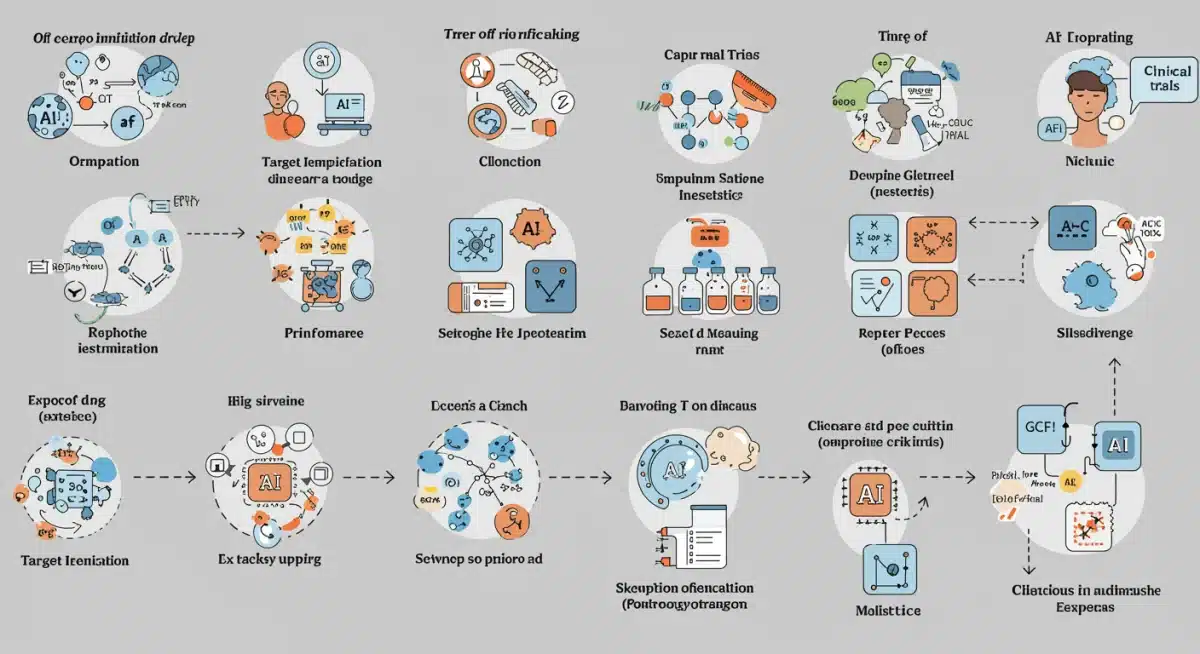
The seamless integration of diverse data types coupled with powerful predictive modeling is what truly differentiates leading AI platforms. This capability allows them to generate hypotheses, test them virtually, and refine them with unprecedented speed, thereby directly impacting the time-to-market for new drugs.
Ultimately, the speed at which new drugs can be discovered and developed is directly proportional to the sophistication of data integration and the accuracy of predictive modeling. Platforms excelling in these areas will undoubtedly lead the charge in accelerating time-to-market.
Challenges and Limitations in AI-Driven Drug Discovery
Despite the immense promise, AI-driven drug discovery is not without its challenges and limitations. Addressing these is crucial for realizing the full potential of these technologies and ensuring responsible innovation.
One significant hurdle is the quality and availability of data. AI models are only as good as the data they are trained on, and in biology and medicine, data can often be noisy, incomplete, or biased. Ensuring access to large, high-quality, and ethically sourced datasets remains a critical challenge for many platforms. Furthermore, the interpretability of AI models, particularly deep learning models, can be a limitation. Understanding why an AI makes a certain prediction is vital for scientific validation and regulatory approval.
Regulatory Hurdles and Validation
The regulatory landscape for AI-driven drug discovery is still evolving. Regulatory bodies like the FDA are working to establish guidelines for the use of AI in drug development, but the novelty of these approaches presents unique challenges for validation and approval.
- Data Standards: Establishing universal data standards for AI input and output is crucial for regulatory review.
- Model Transparency: Demonstrating the reliability and interpretability of AI models to regulators is a complex task.
- Clinical Trial Design: Adapting clinical trial designs to incorporate AI-generated insights requires innovative approaches.
Navigating these regulatory complexities effectively will be a key differentiator for platforms aiming for rapid market entry.
Another limitation is the cost of developing and maintaining these advanced AI infrastructures. The computational power, specialized talent, and extensive data required represent significant investments. Overcoming these challenges will require collaborative efforts between technology providers, pharmaceutical companies, regulatory agencies, and academic institutions.
In conclusion, while AI offers unparalleled opportunities for accelerating drug discovery, acknowledging and proactively addressing its inherent challenges—from data quality to regulatory pathways—is essential for sustainable progress and achieving the fastest time-to-market.
Comparative Analysis: Which Platforms Lead in 2025?
In 2025, several AI platforms stand out for their potential to deliver the fastest time-to-market in drug discovery. This assessment is based on their demonstrated capabilities in accelerating key stages, their technological sophistication, and their strategic partnerships.
Platforms that excel in integrating diverse data sources with advanced predictive modeling, particularly for target identification and lead optimization, are poised to lead. Companies like Exscientia, with their end-to-end AI-driven drug design, and Atomwise, with their highly efficient virtual screening, are strong contenders. Recursion Pharmaceuticals’ unique phenotypic screening approach also positions it favorably for identifying new therapeutic opportunities rapidly.
Key Differentiators for Speed
The platforms achieving the fastest time-to-market share several critical characteristics:
- Integrated Workflows: Seamless integration of AI across multiple drug discovery stages, minimizing handoffs and delays.
- Proprietary Datasets: Access to large, unique, and high-quality proprietary datasets for superior model training.
- Scalable Infrastructure: Robust computational infrastructure capable of handling massive data and complex simulations.
- Strategic Partnerships: Collaborations with pharmaceutical companies and academic institutions to validate and scale their discoveries.
These differentiators allow platforms to not only identify promising candidates faster but also to optimize them more efficiently, ultimately reducing the overall development timeline.
While a definitive ‘winner’ is difficult to declare as the field is dynamic, platforms demonstrating a holistic approach to AI integration, combined with strong data governance and collaborative strategies, are consistently showing the most promise for accelerating time-to-market in 2025. Their ability to deliver tangible results, backed by robust scientific validation, will ultimately determine their leadership in this competitive landscape.
In conclusion, the leading AI platforms in 2025 are those that have successfully built integrated, data-rich, and scalable solutions for drug discovery, demonstrating a clear path to significantly reducing time-to-market through technological prowess and strategic execution.
The Future Outlook: AI’s Evolving Role and Impact
The role of AI in drug discovery is far from static; it is continually evolving, driven by advancements in algorithms, computational power, and a deeper understanding of biological systems. The future outlook suggests an even more pervasive and transformative impact on the pharmaceutical industry.
We can anticipate AI becoming an indispensable tool at every stage of drug development, from initial conception to post-market surveillance. The integration of quantum computing with AI, though nascent, holds the potential to unlock even more complex simulations and accelerate drug design to unprecedented levels. Furthermore, the increasing availability of real-world evidence and digital biomarkers will enhance AI’s ability to predict drug efficacy and safety in diverse patient populations, paving the way for truly personalized medicine.
AI and Personalized Medicine
AI’s capacity to analyze individual patient data, including genomic profiles, medical history, and lifestyle factors, will be central to the advancement of personalized medicine. This will enable the development of drugs tailored to specific patient subgroups, improving treatment outcomes and reducing adverse effects.
- Patient Stratification: AI can identify patient subgroups most likely to respond to a particular therapy.
- Biomarker Discovery: Machine learning helps in discovering novel biomarkers for disease diagnosis and treatment monitoring.
- Drug Repurposing: AI platforms can identify new uses for existing drugs based on individual patient characteristics.
This shift towards personalized approaches will not only improve patient care but also contribute to more efficient clinical trials by targeting the right patients from the outset.
The ongoing development of explainable AI (XAI) will also address concerns about model interpretability, fostering greater trust and facilitating regulatory acceptance. As AI becomes more integrated into the drug discovery ecosystem, it will democratize access to advanced research capabilities, empowering smaller biotech firms and academic institutions to contribute significantly to innovation.
Ultimately, the future of AI in drug discovery is one of continuous innovation and integration, promising to deliver not just faster time-to-market, but also more effective, safer, and personalized treatments for patients worldwide. The collaborative efforts across industry, academia, and regulatory bodies will be crucial in shaping this exciting future.
| Key Aspect | Impact on Time-to-Market |
|---|---|
| Target Identification | AI accelerates identification of promising drug targets, reducing initial research phases. |
| Lead Optimization | AI designs and refines molecules faster, improving efficacy and reducing experimental cycles. |
| Data Integration | Unified data analysis enhances predictive accuracy, streamlining decision-making. |
| Regulatory Navigation | AI aids in generating robust data for regulatory submissions, potentially speeding approval. |
Frequently Asked Questions About AI in Drug Discovery
The primary advantage of AI in drug discovery is its ability to significantly accelerate the identification and optimization of drug candidates. By analyzing vast datasets and performing complex simulations, AI reduces the time and resources traditionally required for preclinical research, leading to a faster transition from concept to clinical trials.
AI platforms reduce time-to-market by streamlining several key stages. They accelerate target identification, optimize lead compounds more efficiently, predict molecular interactions with higher accuracy, and identify potential drug repurposing opportunities. This reduces experimental cycles and focuses resources on the most promising avenues.
AI platforms for drug discovery analyze a wide range of data, including genomic sequences, proteomic structures, chemical libraries, clinical trial results, and real-world patient data. This diverse data input allows AI to build comprehensive predictive models and uncover insights that are critical for drug development.
Yes, significant challenges include ensuring high-quality, unbiased data for training AI models, addressing the interpretability of complex AI decisions for scientific and regulatory validation, and navigating the evolving regulatory landscape for AI-driven therapies. The cost of developing and maintaining advanced AI infrastructure is also a factor.
AI will revolutionize personalized medicine by enabling the analysis of individual patient data to tailor treatments. It will help stratify patients, discover novel biomarkers, and identify optimal drug repurposing opportunities for specific patient profiles. This will lead to more effective and safer therapies customized to individual needs.
Conclusion
The comparative analysis of leading AI platforms for drug discovery in 2025 unequivocally demonstrates their transformative potential in accelerating time-to-market. By leveraging advanced machine learning, robust data integration, and strategic partnerships, platforms like Exscientia, Atomwise, and Recursion Pharmaceuticals are setting new benchmarks for efficiency and innovation. While challenges related to data quality, regulatory frameworks, and interpretability persist, the continuous evolution of AI promises an even more profound impact on pharmaceutical research. Ultimately, the platforms that can seamlessly integrate AI across the entire drug development pipeline, from target identification to personalized medicine, will be instrumental in bringing life-saving therapies to patients faster than ever before, reshaping the future of healthcare.